【 AI News | Editor: Sandy】
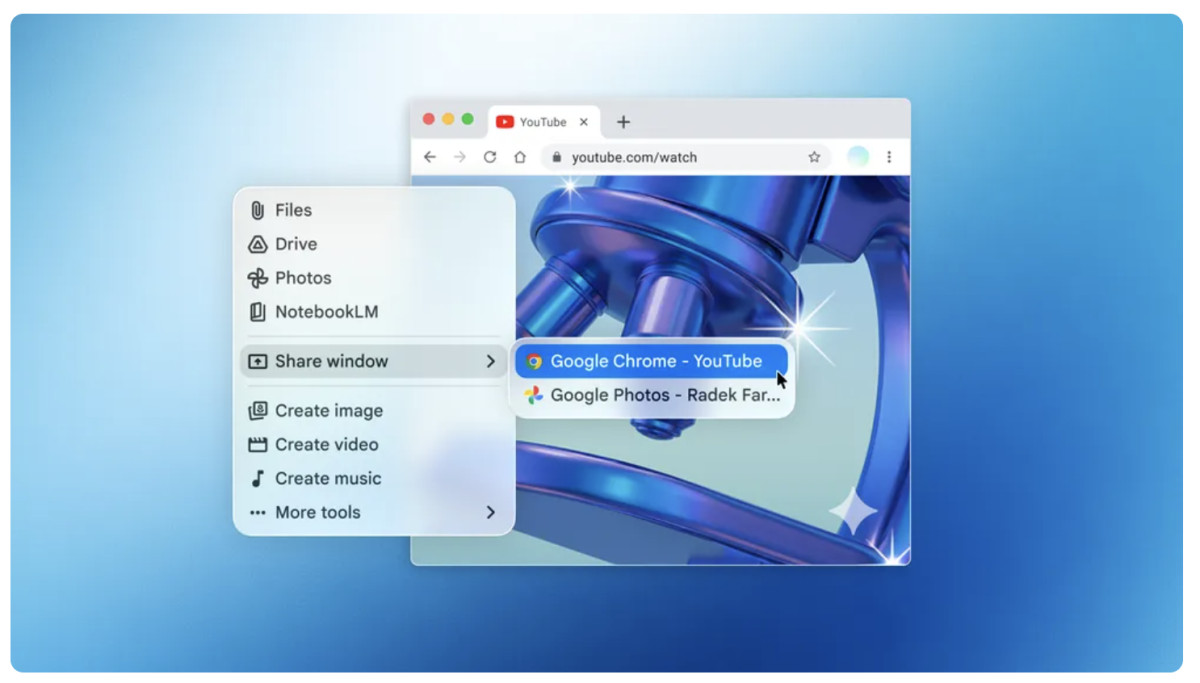
Google’s newly released Gemini for Mac looks, at first glance, like a standalone macOS app. In reality, it is better understood as a direct assault on the desktop entry point. According to the official page, “Gemini for macOS - your native AI desktop app” (https://gemini.google/mac/), the new app can be summoned with Option + Space once installed, and can answer questions in real time based on documents, code, or data visible on the screen through window sharing. It also syncs with the same Google account across mobile and web, while folding image-generation tool Nano Banana and video-generation tool Veo into the same desktop experience. The implication is clear: Google no longer wants Gemini to remain inside a browser tab. It wants the service at the front line of every window switch, information lookup, and creative workflow on the Mac.
From Chatbot to Persistent Desktop Assistant
What matters most about this launch is not simply that Gemini now has a Mac app, but how Google is redefining the product’s place in users’ routines. According to the official page, Gemini for Mac is built not around long-form conversation, but around a workflow in which users can get answers without changing screens. The global shortcut Option + Space makes Gemini feel like a hybrid of Spotlight, instant search, and conversational assistant. Users no longer need to open a browser, sign into a website, upload a file, and only then ask a question. Instead, they can invoke Gemini directly from the task at hand and use the current window as context.
That marks a meaningful departure from the earlier generation of generative AI products. In the past, such tools usually required users to leave what they were doing and switch to a separate interface to type prompts. Google is now trying to insert Gemini into the gaps between tasks. The official page explicitly states that the app can answer based on documents, code, or data visible in a shared window; if users want Gemini to read the full contents of a browser page, they must also grant Accessibility permissions in macOS Privacy & Security settings (https://gemini.google/mac/). That detail matters. It suggests that generative AI is moving beyond answering prompts and toward understanding the screen environment itself.
The Technical Edge Lies Less in the Model Than in the Interface Layer
Google did not use the Mac announcement to dwell on a new foundation model. Instead, it focused on interaction design. That reflects a broader shift in a maturing market: as the performance gap between large models gradually narrows, the real differentiators are less likely to be raw parameters than speed of access, the ability to capture context, and consistency across devices.
According to the official page, Gemini for Mac supports synced chat history and memory, suggesting that Google is extending a single Gemini identity across desktop, web, and mobile. That makes Gemini feel less like a one-off chat session and more like a persistent cross-device service. More revealing still is the fact that Google bundles Nano Banana and Veo into the desktop narrative. According to Google’s official post, “Generate videos in Gemini and Whisk with Veo 2” (https://blog.google/products-and-platforms/products/gemini/video-generation/), Veo has already been positioned as the video-generation engine inside Gemini. Meanwhile, according to Google’s official post, “Image editing in Gemini just got a major upgrade” (https://blog.google/products-and-platforms/products/gemini/updated-image-editing-model/), Nano Banana is presented as the latest upgrade to Gemini’s image-generation capabilities. Taken together, this suggests that Google does not merely want Gemini to be a question-answering tool. It wants it to become a multimodal creative workstation on the desktop.
The real technical significance lies not in whether Gemini can generate images and videos; plenty of products can now do that. The more meaningful distinction is that Google is combining multimodal generation with screen context. When users are reading reports, editing slides, reviewing documents, or writing code, desktop Gemini can move within the same workflow from summarisation to rewriting, from visual ideation to video output. That pushes AI beyond the status of add-on and closer to becoming a central operating layer for digital work.
Google’s Real Objective: Control the Edge of the Operating System
Placed on a wider industry map, Google’s strategic logic becomes clearer. Search remains Google’s core business, but generative AI has already begun to weaken the once-stable habit of opening a browser first and searching second. If users grow accustomed to pressing a keyboard shortcut anywhere on screen and asking an AI assistant that can understand the immediate context, the traditional search box ceases to be the only gateway. If Google does not push Gemini into the first layer of the desktop, that position could be taken by OpenAI, Apple, or even Microsoft.
That is why Gemini for Mac may look like an app while functioning more like an intent interface at the system’s edge. Whichever company can most quickly understand what a user is trying to do at any given moment will be best placed to capture the subsequent flows of search, creation, recommendation, and service distribution. Viewed in that light, Gemini for Mac is not a minor product update. It is one move in Google’s effort to defend traffic and relevance in the post-search era.
The American Battlefield: Google Closes in on OpenAI and Apple
The most immediate point of comparison is OpenAI. According to OpenAI Help Center’s “Work with Apps on macOS” (https://help.openai.com/en/articles/10119604-work-with-apps-on-macos), ChatGPT on macOS can also be invoked with Option + Space to open its Chat Bar and begin interacting with the current app. OpenAI goes a step further, stressing that it can read and edit content in specific development tools. In other words, Google is not merely filling a missing slot with a desktop client. It is competing almost directly with the ChatGPT Mac app on interface and use case.
The other unavoidable rival is Apple, and here the contest is subtler. According to Apple’s official “Apple Intelligence” page (https://www.apple.com/apple-intelligence/), Apple repeatedly emphasises that its AI capabilities are built on on-device processing and Private Cloud Compute, with privacy-preserving contextual understanding as the central promise. Apple Intelligence has already been folded into the Mac experience, though not all devices, languages, and regions support it. That creates an almost ironic situation for Google’s Mac app: it is trying to seize an AI entry point on Apple’s platform before Apple has fully secured that position for itself.
More delicately still, Google and Apple may not be rivals alone. According to Reuters’ report, “Apple, Google strike Gemini deal for revamped Siri in major win for Alphabet” (https://www.reuters.com/business/google-apple-enter-into-multi-year-ai-deal-gemini-models-2026-01-12/), the two companies may already be exploring deeper AI cooperation. If that route develops, Google could reach Mac users directly through a standalone Gemini app while also entering Apple’s ecosystem indirectly through system-level assistants. The result would be a rare blend of competition and interdependence: the battle for the entry point continues, even as the underlying capabilities may become shared.
Europe and the Privacy Question: The Closer Desktop AI Gets, the More Friction It Creates
One of desktop AI’s greatest attractions is that it can see what the user is doing. That is also precisely why it raises the strongest regulatory and privacy concerns. Google makes clear on the Gemini for Mac page that users must actively enable Accessibility permissions if they want the app to read a full browser page. Functionally, that makes sense. But it also means the boundary between the assistant and the screen becomes harder to define.
Apple’s response has been to turn privacy into the centre of its AI narrative. Apple stresses that personal information is handled on-device where possible, and only more complex tasks are sent through Private Cloud Compute. That points to a broader divergence now emerging among America’s large technology groups. Google and OpenAI emphasise speed, cross-model capability, and workflow acceleration. Apple emphasises local processing, data minimisation, and trust. In Europe, that distinction may prove especially consequential. Reuters, in its report “Apple to delay launch of AI-powered features in Europe, blames EU tech rules” (https://www.reuters.com/technology/artificial-intelligence/apple-delay-launch-ai-powered-features-europe-blames-eu-tech-rules-2024-06-21/), noted that EU rules had already delayed some of Apple’s AI features. That is a reminder that getting AI into the system depends not only on technical readiness, but on regulatory acceptability.
The China Angle: Competition Is No Longer Just About Models, but About Price and Scenario Penetration
Seen from China, a somewhat different competitive logic is taking shape. Over the past year, the defining feature of the Chinese AI market has not simply been rapid model iteration, but the increasingly aggressive push to make AI products mass-market and free. According to Reuters’ report, “Baidu to make AI chatbot Ernie Bot free of charge from April 1” (https://www.reuters.com/technology/artificial-intelligence/baidu-says-ai-model-ernie-free-april-2025-02-13/), Baidu announced that Ernie Bot would be made free to desktop and mobile users. Meanwhile, according to Reuters’ report, “Alibaba launches AI chatbot service in renewed consumer push” (https://www.reuters.com/world/asia-pacific/alibaba-launches-ai-chatbot-service-renewed-consumer-push-2025-10-23/), Alibaba has also renewed its consumer-facing AI assistant push. That differs from Google’s Mac strategy. Chinese firms are more inclined to use free access, platform traffic, and super-app integration to seize market share, while Google is trying to build stickiness among higher-value users through desktop productivity scenarios.
The broader implication is that the next stage of AI competition is no longer simply about whose model is strongest. It is about who can embed more reliably into everyday situations. China may show that free access and platform integration can rapidly expand penetration. The American market may show that desktop entry points, system permissions, and higher-quality creative tools are better suited to subscription revenue and higher ARPU models. Europe, by contrast, may end up being shaped above all by regulation and data governance.
Market Impact: As AI Moves onto the Desktop, the Rules of Productivity Software Will Be Rewritten
The most immediate effect of Gemini for Mac is that it further compresses the boundary between traditional productivity software and search behaviour. Once AI can explain, summarise, generate, and recommend directly on the screen a user is already reading, many tasks previously spread across search engines, note-taking tools, design software, and parts of customer support and research workflows can be repackaged into a single keyboard-triggered experience.
For Google, that helps shift Gemini from an AI feature people try to a work layer people depend on. For the broader market, it accelerates several changes. First, desktop AI will raise expectations around contextual understanding, making pure chat interfaces look increasingly incomplete. Second, multimodal capabilities will evolve from demonstration features into workflow features, with image and video generation becoming ordinary tools for proposals, marketing, education, and presentations rather than mere entertainment add-ons. Third, competitive advantage will rest less on benchmark scores and more on entry-point design, permission management, latency, subscription packaging, and ecosystem coordination.
The Limits Behind the Gloss: Desktop Presence Is Not the Same as Utility
None of this means Gemini for Mac is without vulnerabilities. The first constraint is permission and trust. Allowing AI to read shared windows, or even fuller content via Accessibility, may improve answer quality, but enterprise users and sensitive industries may not accept such access lightly. The second constraint is the ceiling imposed by the operating system. However hard Google pushes on the Mac, Gemini remains, fundamentally, a third-party app rather than a native Apple system function. If Apple deepens the integration of Apple Intelligence and Siri, Gemini may still find itself constrained by platform rules. The third limitation is behavioural. A shortcut-based entry point may appear efficient, but whether it becomes habitual depends on response speed, accuracy, the cost of false triggers, and whether it is genuinely faster than switching to a browser.
There is also the risk of strategic blur. By folding Nano Banana and Veo into the desktop story, Google makes Gemini more attractive, but also potentially less coherent. Is it a knowledge assistant, a creative platform, or an operating-system-layer agent? The more functions it accumulates, the more important seamless integration becomes. Without that, versatility can begin to look like fragmentation.
The Longer-Term Question: Who Becomes the Default Interface for the Next Generation of Computing?
What makes Gemini for Mac worth watching is not merely that there is one more download link today. It is that the launch points to a larger question likely to shape the next several years: what will the default interface of the next-generation computer actually be? A search box? An app launcher? Or an AI assistant that can see the screen, track context, and carry memory across devices?
Google’s answer this time is unusually direct. It is not waiting for Apple to fully open the system layer, nor is it confining Gemini to the browser. Instead, it is using a Mac app that is light, fast, and close to the working surface to claim position early. That may not immediately alter market share, but it could reshape the dimension on which the contest is fought. In the end, the decisive factor may not be which company has the smartest model, but which one first makes AI feel like a mouse cursor, a notification centre, or Spotlight itself: something default, reflexive, and quietly indispensable. That is the path Gemini has now stepped onto.