

Meta Reboots Its AI Strategy: Muse Spark and the Race Toward Personal Superintelligence
AI News | Editor: Sandy In its latest announcement in April 2026 ( https://ai.meta.com/blog/introducing-muse-spark-msl/ ), Meta Platforms unveiled a new artific
AI News | Editor: Sandy In its latest announcement in April 2026 ( https://ai.meta.com/blog/introducing-muse-spark-msl/ ), Meta Platforms unveiled a new artific
AI News | Editor: Sandy
In its latest announcement in April 2026 ( https://ai.meta.com/blog/introducing-muse-spark-msl/ ), Meta Platforms unveiled a new artificial intelligence model, Muse Spark—marking the first release from its newly formed Meta Superintelligence Labs (MSL). The model has already been deployed within Meta AI apps and web services, with integration into Facebook, Instagram, WhatsApp, and smart glasses expected within weeks. This launch signals a pivotal shift in Meta’s AI strategy: from an open-source model provider to a company focused on consumer-facing AI ecosystems.
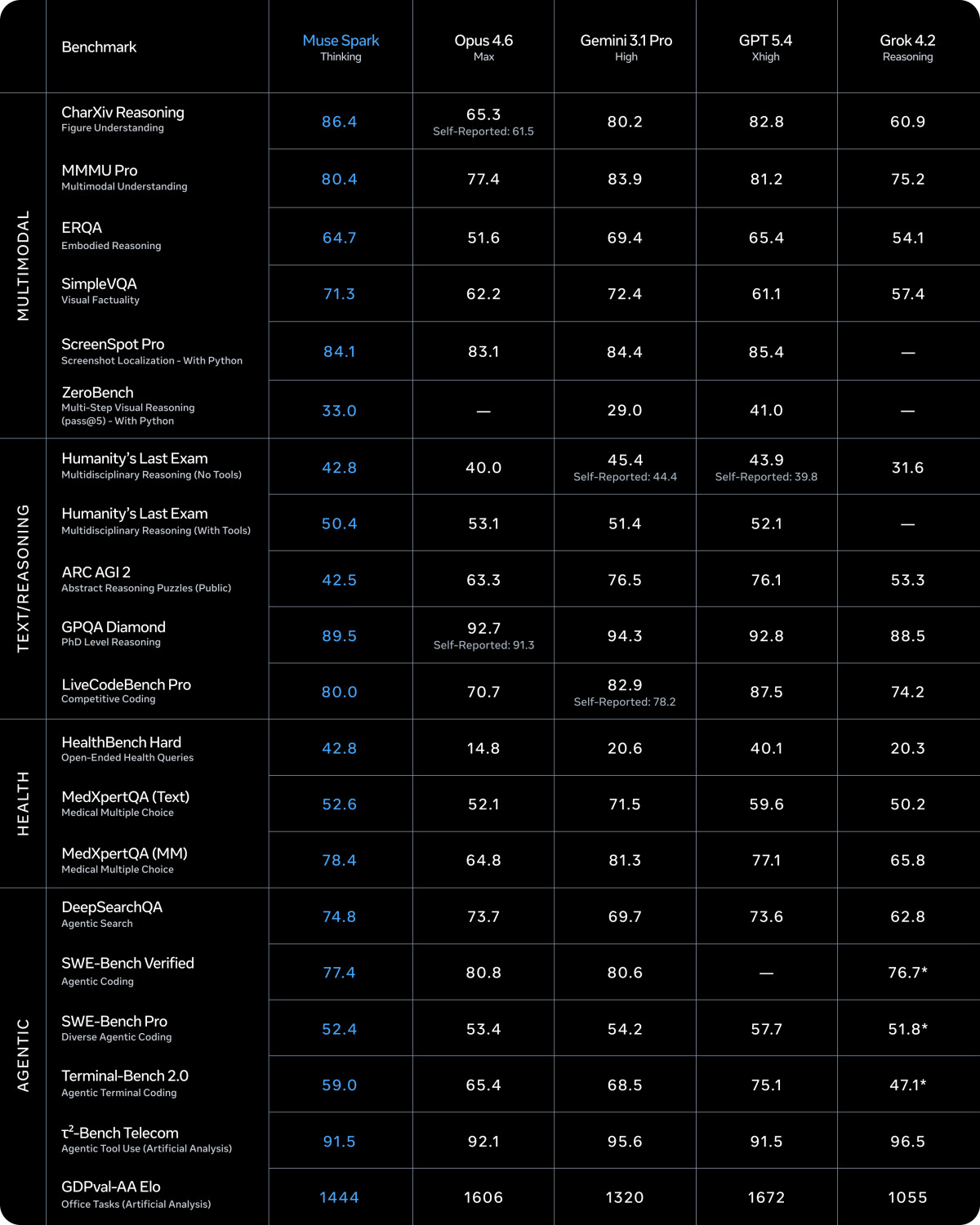
Figure: Performance comparison between Muse Spark and other leading models [Source: Meta]
The introduction of Muse Spark represents more than a product launch—it is a clear strategic recalibration. In recent years, Meta gained prominence through its Llama series, establishing itself as a leader in open-source AI. However, its influence in commercial deployment and product integration lagged behind rivals such as OpenAI and Google. The lukewarm reception of Llama 4 in 2025 further intensified doubts about Meta’s direction.
Muse Spark suggests a departure from prioritising open-source leadership toward strengthening Meta’s own platforms. The company has explicitly stated that the model is designed “for Meta products,” with applications ranging from content recommendations to shopping suggestions and user interaction across its ecosystem.
This shift positions Meta closer to competitors who have tightly integrated AI into their products—OpenAI with ChatGPT and enterprise APIs, and Google with Gemini embedded across Search and Workspace. Yet Meta’s advantage lies elsewhere: not in search or enterprise tools, but in its vast network of social data generated by billions of users.
Technically, Muse Spark is not a simple upgrade to a language model but a broader architectural overhaul. Meta rebuilt its AI infrastructure within nine months to support several key capabilities.
First, the model is natively multimodal. It can interpret text, images, and potentially other forms of data simultaneously—enabling use cases such as identifying products in photos, analysing food nutrition, or even processing health-related imagery. This brings the system closer to real-world applications beyond text-based interaction.
Second, Muse Spark introduces a multi-agent architecture. Instead of producing a single response, the system can orchestrate multiple sub-agents working in parallel. For example, when planning a trip, one agent may handle itinerary design, another compares destinations, while a third searches for activities—before combining outputs into a unified answer. This reflects a broader shift in AI from response engines to task-oriented systems.
Additionally, the model incorporates different reasoning modes, including faster responses for simple queries and deeper “contemplation” modes for complex problems, suggesting an attempt to balance efficiency with analytical depth.
Although Muse Spark may not outperform leading models from Anthropic or Google in all benchmarks, its competitive edge lies in a different dimension.
Meta’s strength is its social ecosystem. Billions of users generate continuous streams of data across Facebook, Instagram, and Threads—forming a rich repository of human behaviour and context. Muse Spark leverages this data to provide more personalised and context-aware recommendations, whether in shopping, lifestyle, or health-related queries.
This differentiates Meta from its rivals. OpenAI focuses on general-purpose intelligence and enterprise adoption; Google emphasises search and knowledge integration. Meta, by contrast, is attempting to build AI that understands people—not just information.
From an international perspective, the launch of Muse Spark reinforces an emerging three-pole structure in the AI industry: established US tech giants (Meta, OpenAI, Google), specialised AI firms such as Anthropic, and Chinese players including Baidu and Alibaba.
Compared with Google’s Gemini, Muse Spark still trails in certain advanced reasoning tasks. Against OpenAI’s models, its enterprise ecosystem remains less mature. Meanwhile, Anthropic continues to differentiate itself through safety-focused design. Meta’s counterpositioning lies in consumer use cases and social integration.
While the initial rollout is concentrated in the United States, Meta has signalled plans to expand into high-growth markets such as India, highlighting its global ambitions. Competition with Chinese firms may intensify in these regions, where mobile-first ecosystems and super-app models are already well established.
Perhaps the most consequential aspect of Muse Spark is not its technical capability, but its commercial implications.
The traditional internet economy has been built around search intent—users actively query platforms, which then provide results. Meta appears to be shifting toward an “influence-driven” model, where AI anticipates needs based on user behaviour, social context, and preferences.
If successful, this approach could redefine digital advertising and e-commerce. Instead of responding to explicit demand, platforms could shape decision-making upstream—positioning Meta not merely as a distribution channel, but as a decision engine.
The launch also serves as a test of Meta’s substantial AI investments. The company plans to spend up to $100bn on AI infrastructure in 2026, alongside aggressive hiring and acquisitions to build MSL.
Initial market reactions have been cautiously optimistic. Analysts view Muse Spark as a step forward in restoring Meta’s competitiveness in AI, with positive movements in its stock price reflecting renewed confidence. However, some remain sceptical, pointing to gaps in coding capabilities and high-level reasoning compared with leading models.
Despite its promise, Muse Spark faces significant challenges.
On the technical side, its multi-agent system and multimodal features remain relatively new, and their performance in complex, real-world scenarios is yet to be fully proven. Reliability and consistency will be crucial, especially if the model is to support enterprise or mission-critical applications.
Equally important is the issue of trust. As AI begins to influence health advice, purchasing decisions, and everyday behaviour, questions around accuracy, bias, and accountability become more pressing. While Meta has collaborated with medical professionals to improve certain outputs, regulatory and ethical uncertainties remain.
Moreover, the decision to keep Muse Spark closed-source could limit its adoption among developers—potentially weakening the community-driven momentum that fuelled Llama’s earlier success.
In the longer term, Muse Spark points toward a broader transformation in the role of AI. Rather than functioning as a tool for answering questions, AI is evolving into an intermediary for decision-making.
As systems become more capable of understanding context, preferences, and multimodal inputs, their influence will extend across retail, healthcare, entertainment, and social interaction. The competitive battleground is shifting—from who builds the best model to who integrates AI most deeply into everyday life.
Meta is clearly betting on the latter.
Muse Spark may not yet represent a technological breakthrough that surpasses all rivals, but it signals a distinct strategic direction—one centred on personalisation, social data, and consumer experience. Whether this approach can rival the general-purpose AI strategies of OpenAI and Google remains uncertain. What is clear, however, is that the future of AI competition will be shaped not only by intelligence, but by intimacy—how closely technology can align with the rhythms of human life.
Leave your name and email to receive future updates from our blog and product insights.
AEO | Editor: Adda Lin AI Overviews Are Not Just a New Feature. They Change the Narrative Structure...
Read Article
AI News | Editor: Sandy Anthropic’s latest launch, Claude Code Routines, pushes AI coding tools from...
Read Article
AI News | Editor: Sandy Google has moved artificial intelligence one step closer to the everyday act...
Read Article
Background This case features a dental clinic offering a wide range of services. The clinic already...
Read Article
【 AI News | Editor: Sandy】 Google’s newly released Gemini for Mac looks, at first glance, like a s...
Read Article
AI News | Editor: Sandy On April 16th 2026 Anthropic officially unveiled Claude Opus 4.7 and made it...
Read Article
AI Software | Editor: Sandy Flux AI is an all-in-one platform that combines AI image generation, ima...
Read Article
AI News | Editor: Sandy On April 10, Anthropic launched the beta version of “Claude for Word”, embed...
Read Article
In today’s increasingly competitive pet food market, many e-commerce brands face the same challenge:...
Read Article
AI News | Editor: Sandy The latest development surrounding Anthropic is not merely a product update....
Read Article
AI News | Editor: Sandy On March 31st 2026 OpenAI published an announcement of unusual weight: the c...
Read Article
ChatGPT Applications | Edited by Jason Chen When organizations begin adopting generative AI, the fir...
Read Article
AI News | Editor: Sandy On April 8, 2026, Anthropic unveiled “Claude Managed Agents,” a release that...
Read Article
Opinion / In-depth Analysis | Editor: Sandy As generative artificial intelligence evolves from answe...
Read Article
ChatGPT Applications | Edited by Jason Chen In the age of social media dominance, Facebook (FB) has...
Read Article
Pimker - The AI marketing platform built for businesses
© Pimker 2026 The AI marketing platform built for businesses All rights reserved.