AEO | Editor: Adda Lin
AI Overviews Are Not Just a New Feature. They Change the Narrative Structure of Search Results.
The importance of AI Overviews does not lie in Google simply adding another module. It lies in the fact that the search results page is shifting from “listing links” to “assembling answers directly.”
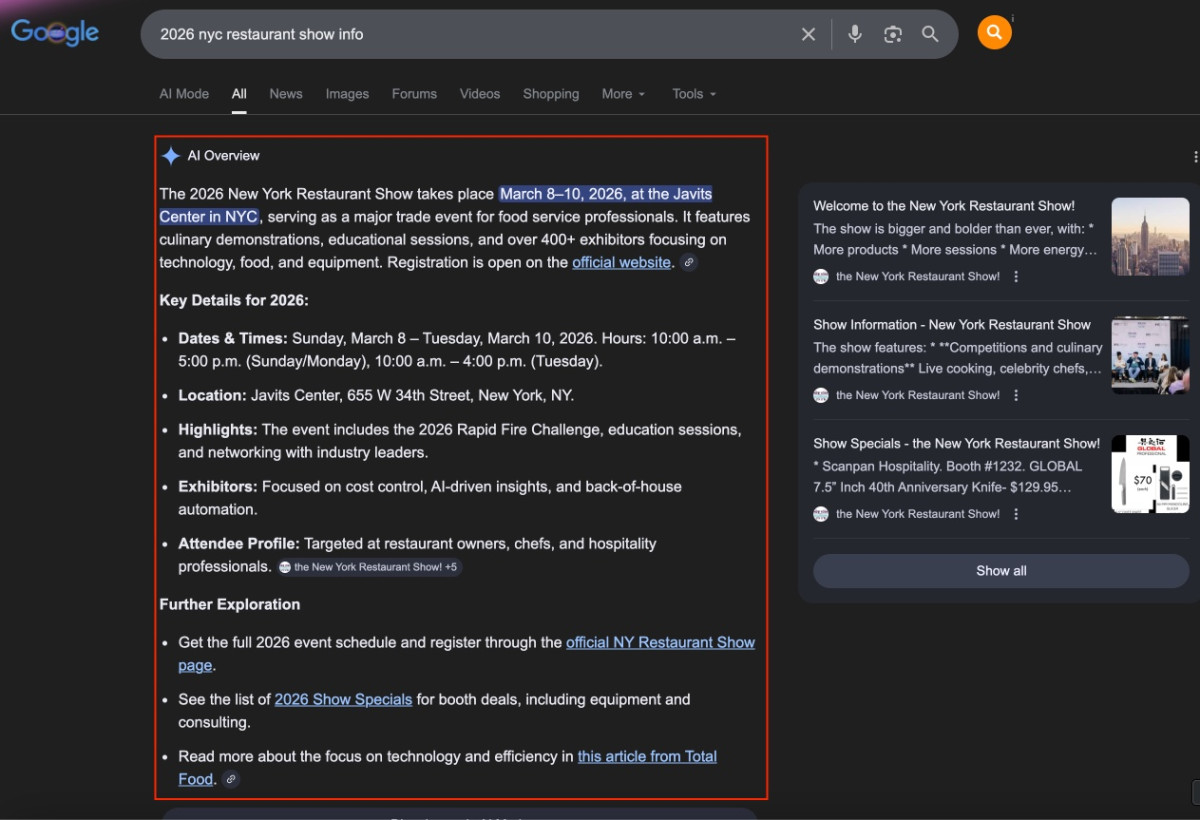
Figure: AI summary is a feature on search results pages where artificial intelligence automatically organizes and displays key information.
This change means search engines are no longer just helping users find a few potentially useful pages. They are increasingly trying to understand the question first, extract information from multiple sources, and combine it into a response that feels more complete and efficient.
For SEO, this is not a minor adjustment. It is a rewrite of the logic of visibility. The competition used to center on blue-link rankings. Now there is another layer of competition: whether a site’s content can become a source that AI systems choose to cite when composing an answer.
As a result, content strategy, brand authority, topical architecture, and site quality no longer affect only organic rankings. They now directly influence whether a brand can enter the most visible layer of AI search.
AI Overviews Reflect Google’s Redefinition of the Search Experience
What makes AI Overviews worth watching is not just the integration of generative AI into search. It is the fact that Google is redefining what a “good search experience” means.
In the traditional search model, Google’s value was in ranking information. In the AI Overviews model, that value extends further into organizing information, compressing context, and even pre-answering complex questions.
Google Search Central notes in “AI features and your website” (https://developers.google.com/search/docs/appearance/ai-features) that features such as AI Overviews and AI Mode integrate relevant links into search to help users find information more quickly, while also creating visibility opportunities for a wider range of websites. That helps explain why the role of the search results page is no longer limited to listing candidate answers. It is beginning to assemble answers proactively.
This shift is closely tied to the capabilities of generative AI. Large language models are good at understanding natural language, identifying intent, integrating information from different fragments, and turning scattered material into readable responses. Once that capability is placed inside the search interface, the search engine stops being just an indexing tool and starts acting more like an interpreter and synthesizer.
From the platform’s perspective, the product logic is clear. Users want answers faster, and Google wants to keep more search activity inside its own interface, improve search satisfaction, and preserve its leadership in search during the generative AI era.
Google also signaled this direction clearly in “Generative AI in Search: Let Google do the searching for you” (https://blog.google/products-and-platforms/products/search/generative-ai-google-search-may-2024/), where it indicated that AI Overviews would continue expanding and become a more important part of the search experience. That suggests AI search is not a short-term experiment, but part of a broader platform direction.
AI Overviews, then, are not just a product update. They are a strategic move that both responds externally to the rise of generative AI and reinforces Google’s position internally as the primary search gateway.
The Real Shift Is That Visibility No Longer Depends on Rankings Alone
Before AI Overviews, the core objective of most SEO work was straightforward: push pages as high as possible in organic search results.
In the new search environment, rankings still matter, but they are no longer the only ticket in. Because AI Overviews draw from multiple sources, some content may still be cited even if it is not in the very top organic positions, simply because a particular passage is clear enough, trustworthy enough, or well-suited to a sub-question.
This suggests that search engines are starting to separate “overall page ranking” from “the value of specific information within a page.” Websites are no longer competing only on which page is strongest overall. They are also competing on which content fragments are most understandable and usable to machines.
From a content strategy perspective, this changes how articles need to be written. Many pages in the past were designed around serving a single keyword. Now they increasingly need to cover the main topic, related questions, definitional distinctions, comparative perspectives, and practical contexts, so the page still has a chance to be cited when facing layered queries.
In other words, the unit of SEO competition is gradually expanding from the URL to the ability to demonstrate topical understanding.
AI Search Cares More About Topical Completeness Than Isolated Keyword Matching
This is where AI and SEO begin to intersect in a much deeper way.
Generative search does not simply detect a keyword and then retrieve the most relevant page. It breaks the question down into multiple intents and subtopics, then looks across indexed content for information that can support an answer. This changes content strategy from being keyword-led to being more topic-led and entity-led.
A topic-led approach means content is no longer just answering a phrase. It needs to build a knowledge structure around the problem. An entity-led approach means search engines care more about which people, brands, products, concepts, scenarios, and relationships are present in the content.
That is why content most likely to appear in AI Overviews is usually not the kind that repeats a keyword over and over. It is the kind that explains the topic clearly enough for the search engine to understand what problem the page solves, which core concepts it covers, and which kind of search intent it addresses.
This also points to something important: SEO is not being replaced by AI. It is being pushed to evolve into something closer to knowledge design and content modeling.
Google Search Central explains in “A guide to Google Search ranking systems” (https://developers.google.com/search/docs/appearance/ranking-systems-guide) that Google still uses multiple ranking systems and signals to evaluate relevance and usefulness. In other words, AI Overviews may change how results are presented, but they do not erase the underlying requirements around content quality and topical understanding.
Brand Authority Is Shifting From a Bonus to a Baseline Requirement
Within the context of AI Overviews, brand authority is taking on a much heavier role.
The reason is simple. When a search engine uses AI to assemble answers for users, it takes on more risk than when it merely lists links. If the synthesis is inaccurate or the citation is misplaced, the damage affects both user experience and trust in the platform.
That makes Google more likely to rely on sources that are already recognized, repeatedly referenced, and perceived as credible within a specific topic. That credibility does not come only from the page itself. It also comes from whether the brand regularly appears in industry conversations, has a track record of expert content, is mentioned by other sites, and has established clear visibility within certain verticals.
As a result, the boundary between brand building and SEO is becoming increasingly blurred. PR, content marketing, expert reputation, social discussion, and branded search demand were once treated as higher-level brand activities. Now they may also influence visibility in AI search indirectly.
Google Search Central notes in “Our latest update to the quality rater guidelines: E-E-A-T gets an extra E for experience” (https://developers.google.com/search/blog/2022/12/google-raters-guidelines-e-e-a-t) that experience, expertise, authoritativeness, and trust remain key concepts in evaluating content quality. While this does not translate directly into a single ranking factor, it clearly reflects the direction of search engines’ preference toward credible content.
For businesses, this is a practical warning. A site without strong brand recognition will likely face more difficulty not only in rankings, but also in being trusted as a source within AI-composed answers.
Technical SEO Is Not Outdated. It Has Become the Minimum Requirement for Being Usable by AI.
When people talk about AI search, one common misconception quickly appears: the idea that writing AI-friendly content is enough.
In reality, technical SEO is still foundational, and its importance has not diminished. Whether the final search experience is a traditional list of links or an AI-generated summary, the precondition is the same: the search engine must be able to crawl, understand, index, and interpret the page.
If a site has crawling barriers, indexing issues, confusing structure, slow load speed, poor mobile usability, or content buried beneath ads, pop-ups, and other disruptive elements, even excellent content may fail to enter the search system’s decision-making process effectively.
This matters even more in the age of AI Overviews, because generative search depends not only on whether a page exists, but on whether its information can be extracted accurately. Clear page structure, well-defined semantic hierarchy, prominent main content, and logical paragraph flow all make it easier for search engines to understand and cite the content.
In that sense, technical SEO is shifting from a ranking enhancer to a prerequisite for whether content can even enter the AI engine’s interpretation pipeline.
Content Strategy Is Moving From Publishing More Articles to Publishing More Integratable Content
This is where content teams need to rethink their approach most seriously.
Many websites once grew by continuously expanding page counts around large sets of keyword topics, aiming to accumulate long-tail traffic at scale. That approach can still have value, but if the content is highly repetitive, fragmented too narrowly, or lacking in substance, AI search may not favor it.
What AI Overviews are more likely to prefer is content that explains the issue fully, offers credible information, presents ideas clearly, and includes specific enough details. That does not necessarily mean every article has to be long. It means the page must contain enough informational density and structural quality for systems to extract useful passages from it.
As a result, content strategy is shifting from “cover more keywords” to “build stronger topical assets.” An article that can address definitions, common questions, use cases, comparative context, limitations, and practical recommendations all at once is more likely to be useful to AI search systems than several thin pages split across the same topic.
Google Search Central states in “Creating helpful, reliable, people-first content” (https://developers.google.com/search/docs/fundamentals/creating-helpful-content) that Google’s ranking systems prioritize content that is helpful, reliable, and created for people rather than pages designed mainly to influence rankings. That makes topical depth, information density, and completeness far more practical advantages in the age of AI search.
This also means the role of content editors is evolving. The job is no longer just to produce articles, but to plan knowledge architecture, improve information usability, and help a brand build a stable, recognizable, and citable content system around a topic.
Truly Valuable Content Serves Human Readers and Machine Extraction at the Same Time
A key principle in the age of AI search is not to write for machines, but to create content that works for both people and machines.
If content contains only keyword placement without clearly answering the question, human readers will not find it useful, and machines may not know what to cite. On the other hand, if content contains strong opinions but has loose structure, vague definitions, and too little factual support, search engines will struggle to extract it consistently.
That is why the most effective content formats going forward tend to share several characteristics. They define the topic quickly, then expand into background, methods, distinctions, and limitations. They translate abstract concepts into understandable language. They avoid vague conclusions and provide concrete information, scenarios, or examples. They also make important passages sufficiently self-contained so they can be understood and cited independently.
This kind of writing already reflects what good content should look like. The difference is that in the AI search era, those qualities are amplified into more direct visibility opportunities.
Google Search Central also notes in “Google Search’s guidance on using generative AI content” (https://developers.google.com/search/docs/fundamentals/using-gen-ai-content) that generative AI can help with research, organization, and initial drafting, but pages produced at scale without adding value may still create quality risks. That makes one thing clear: AI tools can improve efficiency, but they cannot replace credibility or original value.
Traffic Distribution Will Be Reallocated, and Websites Can No Longer Measure Success by Clicks Alone
One of the most immediate effects of AI Overviews is the possibility that traffic distribution will change.
When the search results page already provides a synthesized answer, some informational queries that used to generate clicks to websites may now be satisfied directly on the results page. That means some sites may retain visibility while receiving fewer clicks than they once did.
This is especially important for content sites, publishers, brand websites, and B2B informational properties. It forces teams to rethink whether SEO performance can still be measured mainly through sessions, pageviews, or the ranking of a single keyword.
What may matter more going forward is a brand’s total visibility across search results, whether it is cited in AI summaries, whether it appears in decision-stage high-intent queries, and whether that visibility still drives brand recall, lead generation, inquiries, and conversions.
In other words, SEO is moving gradually from being traffic-led to being visibility-led and influence-led. Traffic still matters, but brands that rely only on old metrics may misread their true position in the new search environment.
For Businesses and Brands, This Will Change Content Team KPIs and Collaboration Models
As AI search begins to reorganize the rules of visibility, the boundaries of content team responsibilities will shift as well.
First, SEO is no longer just the SEO team’s job. Brand, PR, product marketing, content editors, technical teams, and even customer questions gathered by sales can all become valuable inputs into AI search performance. Search engines increasingly care about whether a brand has complete signals around a topic, not whether a single article has been superficially optimized.
Second, content KPIs will become more layered. In addition to organic traffic, teams will need to look at branded search growth, visibility across topic clusters, the likelihood of content being cited, how well pages connect to business problems, and whether content supports overall brand trust.
Finally, companies will need stronger topic-based planning rather than fragmented pursuit of trending keywords. The most effective strategy is often not publishing a few new keyword pieces every week, but building lasting depth around selected core topics so that both search engines and the market gradually recognize the brand as a credible source.
This Shift Also Creates New Challenges, Especially for Smaller Brands and Content-Farm-Style Websites
AI Overviews are not an equal opportunity for every website.
For companies that already have strong brand foundations, substantial content assets, and stable technical conditions, this creates a new arena in which their advantages can be amplified. But for brands that lack authority signals, have unstable site quality, or offer limited content depth, the threshold for entering the AI citation layer is significantly higher.
This will also compress some of the room for older SEO tactics. Template pages, keyword stuffing, and outsourced stitched-together articles were once used to chase rankings. In an AI search environment, those approaches are much less likely to hold up over time. Even if such content gets indexed occasionally, it may not have enough credibility or information value to be treated as a citable source.
Another challenge is that performance may not be easy to measure. The triggering conditions, display frequency, cited sources, and placement formats of AI Overviews are still evolving, and the market has not yet developed a fully mature measurement framework. That creates a transition period in which teams must invest strategically while still learning how to validate results.
But that uncertainty is itself one of the clearest signs of a real transition. Teams that build new metrics and workflows earlier are often the ones that accumulate an advantage before the rules fully stabilize.
In the Long Run, AI Search Will Push the Content Industry Toward Higher-Threshold Competition
From a longer-term perspective, AI Overviews reflect not only the evolution of Google Search, but also a rising competitive baseline across the content industry.
The future of content competition will not be defined by who publishes fastest or who covers the most topics. It will be defined by who can continuously provide trustworthy, interpretable, verifiable, and integratable information within a given topic. That shifts content operations closer to brand asset building than to a simple traffic-factory model.
At the same time, generative AI makes large-scale content production easier, which further reduces the scarcity of surface-level content. When nearly anyone can produce article drafts quickly, the truly scarce assets become clear perspective, grounded experience, recognizable brand trust, and editorial ability strong enough to explain complex issues well.
That will push SEO, content marketing, and brand strategy into deeper integration. The websites that perform best in the future will often not be the ones that chase algorithm loopholes most aggressively, but the ones that consistently build credible knowledge, maintain content quality, understand shifts in search intent, and keep their brand consistent across touchpoints.
The Core of the AI Overviews Era Is Not Pleasing the Algorithm, but Becoming a Source Worth Citing
If this entire shift can be distilled into one sentence, the point is not “how to hack AI Overviews,” but “how to become a source that AI search is willing to cite.”
That distinction may sound subtle, but it determines strategic direction. The first framing tends to push teams toward short-term tactics. The second brings the focus back to more durable capabilities such as content quality, topical depth, brand trust, and site experience.
From an SEO perspective, traditional best practices still matter, but basic optimization alone is no longer enough. From an AI perspective, generative search does not flatten all content value. It makes content with real informational density and authority more likely to be amplified.
That is why AI Overviews matter now. Not only because they are changing the SERP, but because they reveal the direction of the future search ecosystem in advance: search is no longer just about finding pages, but about assembling answers; brands are no longer just competing for rankings, but for trust; and content is no longer just filling space, but becoming a knowledge node that both machines and humans are willing to use.
That is the most concrete point where AI and SEO truly meet today, and it is a change that website owners, content teams, and digital marketing decision-makers can no longer afford to ignore.