AI News | Editor: Sandy
Anthropic on April 17, 2026 formally unveiled “Claude Design”, extending its flagship Claude model from text, code and knowledge work into visual design and prototyping. According to Anthropic’s official announcement, “Introducing Claude Design by Anthropic Labs” (https://www.anthropic.com/news/claude-design-anthropic-labs), the new product is being offered in research preview to Claude Pro, Max, Team and Enterprise subscribers, and is pitched as a way to generate design mock-ups, interactive prototypes, slide decks, one-pagers and marketing assets through conversation. This is not merely another feature launch. It is a fresh sign that the boundary between AI companies and design-software firms is loosening again: workflows once native to design platforms are being absorbed directly into large models.
Claude Is No Longer Just Answering Questions. It Is Starting to Deliver Finished Work
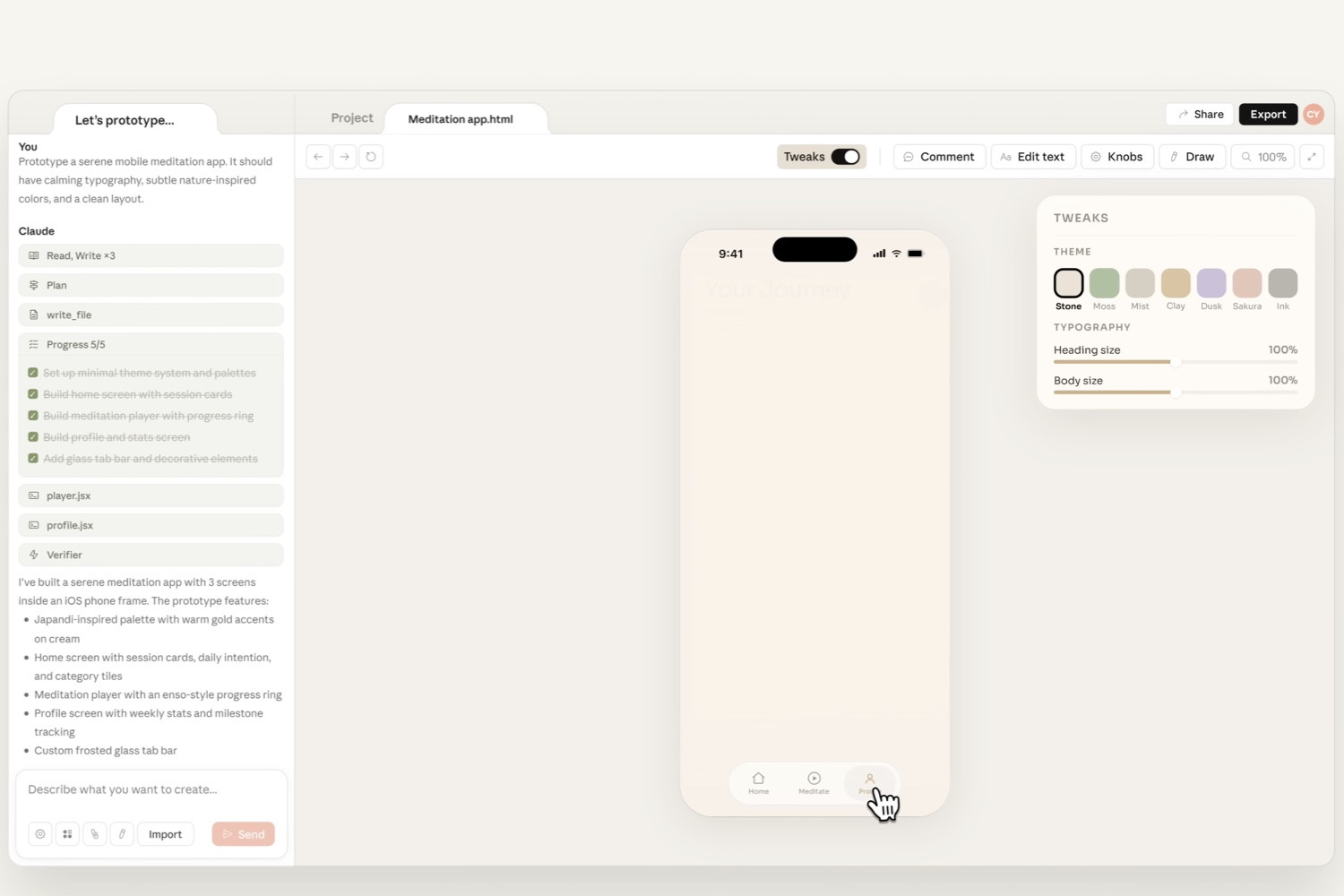
According to Anthropic’s official announcement, “Introducing Claude Design by Anthropic Labs” (https://www.anthropic.com/news/claude-design-anthropic-labs), Claude Design is positioned not simply as a sketching aid, but as a way to “collaborate with Claude to create polished visual work”. Anthropic’s suggested use cases include design exploration, product wireframes, interactive prototypes, fundraising decks, brand presentations and marketing materials, spanning everything from early ideation to internal communication and outward-facing presentation. That marks a notable shift in how Claude is being framed. Until recently, Anthropic had mostly emphasised Claude’s strengths in long-context reasoning, enterprise knowledge work, agentic tasks and software development. Now it is pushing the model beyond answers and towards artefacts. In industry terms, that suggests the unit of competition among large models is moving from response quality to deliverable output.
As TechCrunch noted in its report, “Anthropic launches Claude Design, a new product for creating quick visuals” (https://techcrunch.com/2026/04/17/anthropic-launches-claude-design-a-new-product-for-creating-quick-visuals/), Anthropic is not targeting designers alone. It is also aiming at founders, product managers and other knowledge workers with little or no formal design training. That matters. It suggests Anthropic is not trying simply to replicate a conventional design tool, but to attack one of the slowest and most friction-filled stages of the design process: turning an indistinct idea into a visual draft that can be discussed, shown and approved. In essence, it is recasting the messy front end of design as a workflow driven by natural language.
The Real Innovation Is Not Image Generation, but Workflow Capture
What makes Claude Design notable is not that it can produce visuals, but that it is attempting to wrap an entire chain of work—understanding a brief, generating layouts, maintaining stylistic consistency and exporting deliverables—inside a single model interface. According to Anthropic’s official announcement, “Introducing Claude Design by Anthropic Labs” (https://www.anthropic.com/news/claude-design-anthropic-labs), users can start from text prompts, images, documents or even an existing codebase, ask Claude to produce an initial version, and then refine it through conversation, inline comments, direct edits and detailed controls. More importantly, if granted permission, the system can read a team’s codebase and design files, infer a design system and apply it so that colours, typography, components and brand voice remain consistent.
That makes Claude Design fundamentally different from the typical image-generation tool. Those systems are often good at atmosphere, style and composition. But what companies usually need is not a striking image. They need a slide deck for an internal review, an interactive prototype for user testing, or a landing-page draft close enough to a production product that engineers can pick it up. Claude Design appears to be aimed at this category of working design output, rather than at aesthetic spectacle. Anthropic also allows exports to PDF, PPTX and HTML, and lets work be sent onward to Canva for further editing. That suggests it is not assuming every stage should happen inside Claude. Rather, it is trying to own the front door to the process, while allowing the polishing phase to continue elsewhere.
Opus 4.7 Is the Foundation; Claude Design Is the Surface Layer
To treat Claude Design as merely a new interface would be to understate Anthropic’s intentions. According to Anthropic’s model announcement, “Introducing Claude Opus 4.7” (https://www.anthropic.com/news/claude-opus-4-7), Opus 4.7 is positioned as its most capable generally available model, with improvements in complex software engineering, long-running multi-step tasks, image analysis, instruction following and creative work. Anthropic specifically says Opus 4.7 performs better on high-resolution image understanding than its predecessor, can handle more detailed interface and visual material, and delivers more mature output in documents, presentations and other visual tasks. In other words, Claude Design is not an isolated invention. It is a natural extension of Opus 4.7’s multimodal capacity and long-horizon reasoning.
That technical path points to a broader ambition. Anthropic is not simply trying to build an AI design tool. It is trying to make one model the substrate for work across functions. When a single system can read documents, write code, interpret design references, generate presentations and hand prototypes into downstream development, it is no longer competing merely in the design-software market. It is competing for the broader enterprise productivity stack. Seen this way, Claude Design is not a side feature. It is a significant step in Anthropic’s attempt to turn Claude from a chat assistant into a workplace production interface.
In the American market, Anthropic’s move most directly brushes against Figma, Canva and Adobe. According to Figma’s official pages, “Free AI Design Generator - Design Using AI” (https://www.figma.com/solutions/ai-design-generator/) and “Your Creativity, unblocked with Figma AI” (https://www.figma.com/ai/), Figma has already woven AI into its core narrative, presenting natural-language generation of layouts, visuals and prototypes as part of the product itself. Meanwhile, Figma’s page “Figma Make: Create with AI-Powered Design Tools” (https://www.figma.com/make/) promotes the rapid generation of interactive prototypes from ideas, using real components, data and logic, with the same goal: shortening the distance between concept and product.
Judging from these official descriptions, the overlap between Anthropic and Figma is now considerable. Both are moving beyond static design towards systems in which AI helps generate, iterate and hand off work. The difference lies in direction. Figma began as a design tool and added AI to its workflow. Anthropic began with a large model and is pulling design workflow into it from the outside. That points to a wider industry shift. The contest ahead will not be simply about which design tool is best, but about which platform can catch the user’s intent first, understand the surrounding context, and push the work forward with the least friction.
Google and Chinese Firms Show This Is Not a One-Company Battle
Outside America, Google is also trying to shape AI design as an important frontier. In its official blog post, “Introducing ‘vibe design’ with Stitch” (https://blog.google/innovation-and-ai/models-and-research/google-labs/stitch-ai-ui-design/), Google describes Stitch as an AI-native software design canvas, one that uses natural language to generate high-fidelity interfaces, supports voice-based iteration and tries to bring design closer to development and product execution. The phrase “vibe design” may be marketing language, but it captures a genuine industry direction: design tools are no longer merely canvases. They are becoming systems that interpret intent, retain context and help drive work forward.
China presents a somewhat different competitive logic. Chinese technology firms have in recent years accelerated investment in multimodal models, office AI and content-generation tools, often with strengths in mass-market distribution, integration with platform traffic and fast commercial deployment. Anthropic, by contrast, appears more focused on high-value enterprise workflow, brand consistency and cross-functional collaboration. That suggests the AI design market may not evolve along a single track. One path is likely to serve internal corporate planning and product development. Another is likely to centre on high-volume content production, ecommerce assets and social-media materials. Both may expand rapidly, but their business models and competitive barriers will differ.
Europe’s Regulatory Lens May Shape the Pace of Expansion
Set in a European context, the issue is not just functionality or speed, but governance. According to the European Commission’s page, “AI Act” (https://digital-strategy.ec.europa.eu/en/policies/regulatory-framework-ai), the EU AI Act has become the world’s first relatively comprehensive legal framework for artificial intelligence, with different obligations depending on the risk profile of a system. For tools like Claude Design, which may process company documents, brand assets, design systems and code repositories, requirements around data governance, transparency, supply-chain accountability and enterprise procurement are likely to grow, not shrink. Europe may therefore prove not to be the fastest market for AI design adoption, but one of the earliest to force providers to build trust and compliance into the product itself.
From that perspective, if Anthropic wants Claude Design to penetrate large organisations more deeply, it will need to do more than highlight generation quality. It will also have to strengthen permission controls, auditability, organisational workflow rules and traceability. These capabilities are far less glamorous than generated output, but they often determine whether an AI product remains a demo or becomes a serious procurement candidate.
This Is Not About Replacing Designers, but Rewriting Design Labour
The most obvious question raised by Claude Design is whether it threatens the role of the designer. Based on what has been disclosed so far, a more accurate reading is that it is compressing the first half of the design process, especially the repetitive, high-frequency tasks that require quick visual drafts. According to Anthropic’s official announcement, “Introducing Claude Design by Anthropic Labs” (https://www.anthropic.com/news/claude-design-anthropic-labs), enterprise users are already using the system to turn rough ideas into usable prototypes during meetings, reducing cycles of back-and-forth that used to take far longer. Such examples naturally carry some vendor polish. But they are consistent with a broader pattern: the first tasks AI design systems are swallowing are not final aesthetic judgment, but draft generation, layout exploration, variation testing and communication overhead.
That will alter team structure. Product managers may no longer need to wait for design bandwidth before validating an idea. Marketing teams may generate a first presentation draft in natural language before handing it to brand designers for refinement. Founders may be able to create visual material good enough for discussion without opening a conventional design tool. Over time, designers may not disappear, but their centre of gravity may move away from producing the first version and towards defining systems, maintaining style, safeguarding quality and handling high-value nuance. What AI is displacing here is not design itself, but the portions of design work that are easiest to standardise and most expensive to repeat.
The Deeper Industry Meaning Lies in the Battle for the Entry Point
The larger significance of Anthropic’s launch is that it offers further evidence that the next phase of AI competition will not be only about model capability. It will be about control of the interface through which work begins. Whoever becomes the first place users go to express a need will have the best chance of owning requirement capture, content generation, revision flow, export formats and downstream integration. Claude Design supports exports to PDF, PPTX and HTML, and can pass work to external platforms such as Canva. That suggests Anthropic is not yet trying to seal the ecosystem shut. It is instead trying to become the centre through which intent is first translated into structured work.
Yet the road ahead is hardly clear of obstacles. First, adoption speed will depend heavily on whether companies are willing to let a model read internal codebases and design assets. Second, if generated work repeatedly fails on detail, users will return quickly to familiar professional tools. Third, functional overlap among AI design products is rising fast. From Figma to Google to Anthropic, nearly everyone is chasing the “one prompt to prototype” scenario. The real difference may soon lie less in generation quality itself than in integration depth, ecosystem lock-in and enterprise governance.
Claude Design, then, is more than another product release. It is a clear signal that chatbots no longer aspire merely to answer questions; they are beginning to seize the front end of presentations, design, prototyping and product communication. It may not immediately rewrite the structure of the design industry. But it is likely to accelerate one already-visible trend: over the next few years, the boundaries between design software, office platforms, development pipelines and AI assistants will become far harder to distinguish. When that happens, the more important question will not simply be who gets replaced, but who gets to redefine where value sits inside the new interface of work.