

Clarify brand and service positioning
Help AI understand who you are, what you offer, where you serve, and who your best customers are.
When customers ask ChatGPT, Gemini, Claude, or Google AI Search, AI first needs to understand who your brand is, what you do, who you are best for, and which trust signals support you.
Pimker’s AI optimization method turns existing content, brand data, FAQs, service pages, and update signals into a clearer information structure so search systems and AI answer systems can discover, understand, and update your website more easily.
Built for owners, marketing leads, website managers, and content teams that want to understand the method before adopting Pimker.
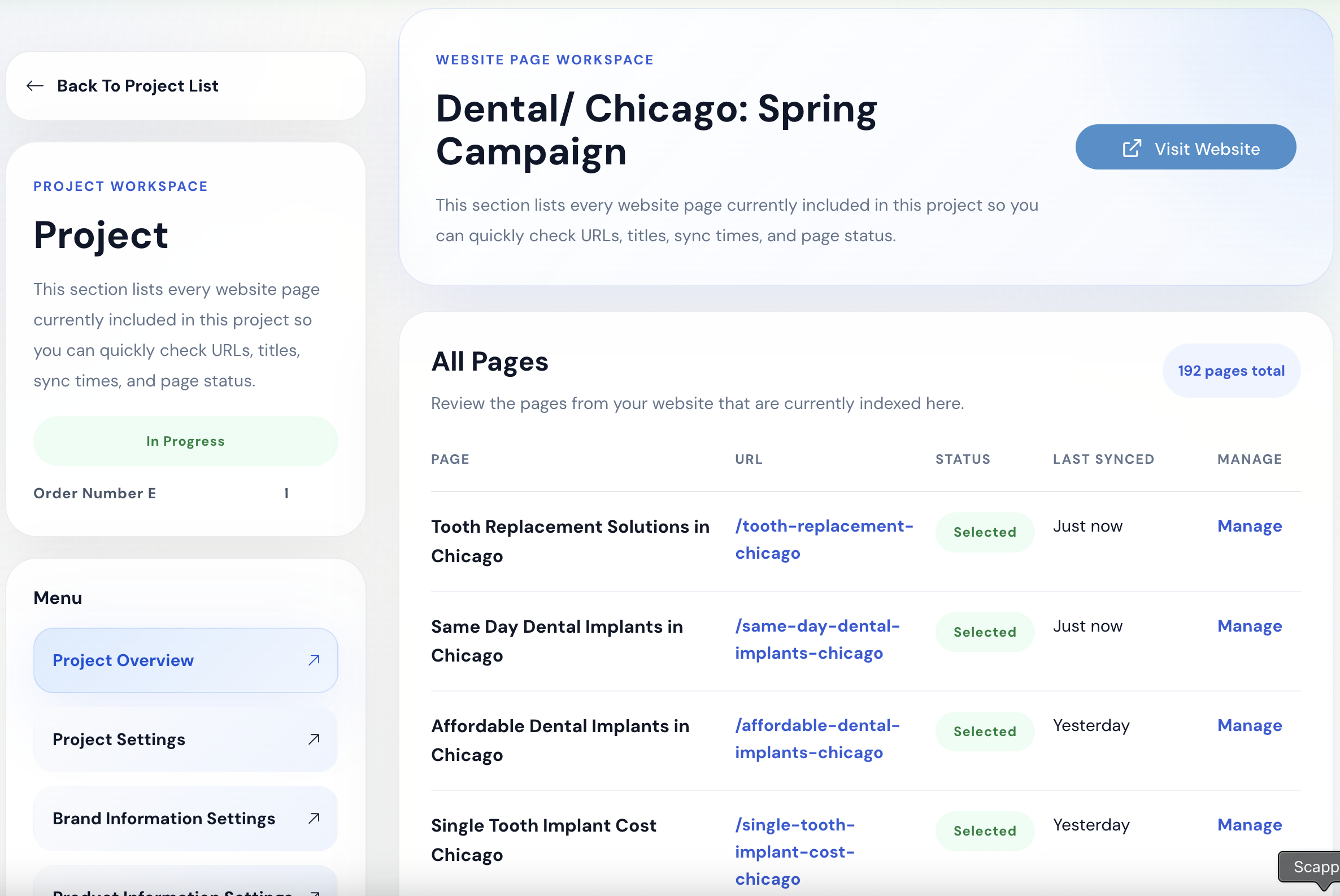
Many websites do not lack content. The problem is that content is scattered, page roles are unclear, FAQs are incomplete, and service descriptions sound like slogans, making it hard for AI to judge which needs the brand fits.
AI optimization does not guarantee that a model will cite you, and it does not turn every page into machine-written copy. The real work is making website content more complete, readable, and connected to user questions.
Help AI understand who you are, what you offer, where you serve, and who your best customers are.
Homepage, service pages, plans, case studies, FAQs, and articles should answer different decision questions.
Turn customer questions and AI evaluation points into clear sections, summaries, and FAQs.
Use sitemaps, page summaries, and content updates so new signals do not happen only once.
The method is not a single trick. It is a structured workflow: audit the current website, complete brand and service context, organize AI-readable content, then keep improving through submission and monitoring.
Check homepages, service pages, product pages, FAQs, articles, case studies, sitemaps, headings, and page status to find what AI cannot easily understand.
Build consistent context around positioning, service scope, regions, market, target customers, common questions, and trust signals.
Turn important services and products into clear pages with audiences, problems, solutions, process, limitations, and CTAs.
Turn user questions into summaries, Q&A, comparisons, steps, and internal links so AI can extract key points more accurately.
Organize page summaries and sitemap updates on the plan cadence so search and AI systems can discover new or updated content faster.
Website content, competitors, search questions, and AI answers all change. Pimker keeps identifying pages and FAQs that need updates.
AI does not only check whether a page has keywords. It needs to understand the page role, content boundaries, best-fit audience, next step, and trust evidence.
Pimker helps organize important pages like data packets: headings, summaries, questions, answers, internal links, and update signals align with one another.
Pimker connects public website content, brand supplemental data, and page update signals into a repeatable workflow, so optimization is not just a one-time copy edit.
Read public pages, brand settings, service lists, FAQs, important pages, and sitemaps.
Find gaps, organize page summaries, improve content structure, internal links, and update signals.
Make the website easier to discover, understand, cite, and re-evaluate over time.
AI optimization should not apply the same copy template to every page. Each page should include the right information for its role.
Clarify positioning, core services, best-fit audience, trust signals, and next steps.
Explain the problem, solution, process, deliverables, limitations, FAQs, case studies, and CTA.
Add specifications, use cases, comparisons, common concerns, pricing logic, and purchase paths.
Answer the questions customers and AI both evaluate, such as process, pricing, fit, limits, and safety.
Show the industry, problem, method, outcome context, and trust signals without exaggerated promises.
Connect educational content back to related service pages so traffic has a conversion path.
Pimker’s method focuses on building understandable foundation signals. It does not frame AI search as a guaranteed ranking, guaranteed citation, or immediate sales promise.
Organize brand, service, FAQ, and page summary signals
Improve content structure and internal links
Support sitemap and important page update signals
Identify content gaps and priorities
Continuously monitor page changes and quality
You do not need to finish everything at once. But the clearer these items are, the easier your website is for search and AI systems to understand.
SEO helps websites get found in search results. AI optimization focuses on whether AI answer systems can understand, summarize, compare, and cite your website. The two should work together.
No. Articles are only one content type. Brand data, service pages, FAQs, page summaries, internal links, sitemaps, and continuous updates are often more important.
Pimker focuses on analyzing, organizing, optimizing, and submitting website content signals. Any direct website changes should be confirmed based on the site condition and administrator approval.
Yes. A one-page site can start by clarifying positioning, service scope, FAQs, contact information, and trust signals, then expand service pages if needed.
This is cumulative work. Timing depends on content quality, page count, update frequency, competition, and external system refreshes. Pimker improves the foundation but does not guarantee a specific AI answer.
Start by auditing important pages and duplicate content, then make sure the homepage, core service pages, FAQs, case studies, and CTAs form a clear path before reorganizing articles and internal links.
You do not need a full redesign or a complete documentation package to start. Use your existing website for an AI visibility check and see where brand, service pages, FAQs, sitemaps, and content structure have gaps.
After you understand the gaps, you can decide whether to begin with the homepage, service pages, FAQs, content submission, or ongoing monitoring.

© Pimker 2026 AI marketing software built for modern businesses All rights reserved.