

What Is E-E-A-T?
E-E-A-T is a concept Google uses to evaluate content quality. It stands for Experience, Expertise, Authoritativeness, and Trustworthiness. In simple terms, E-E-
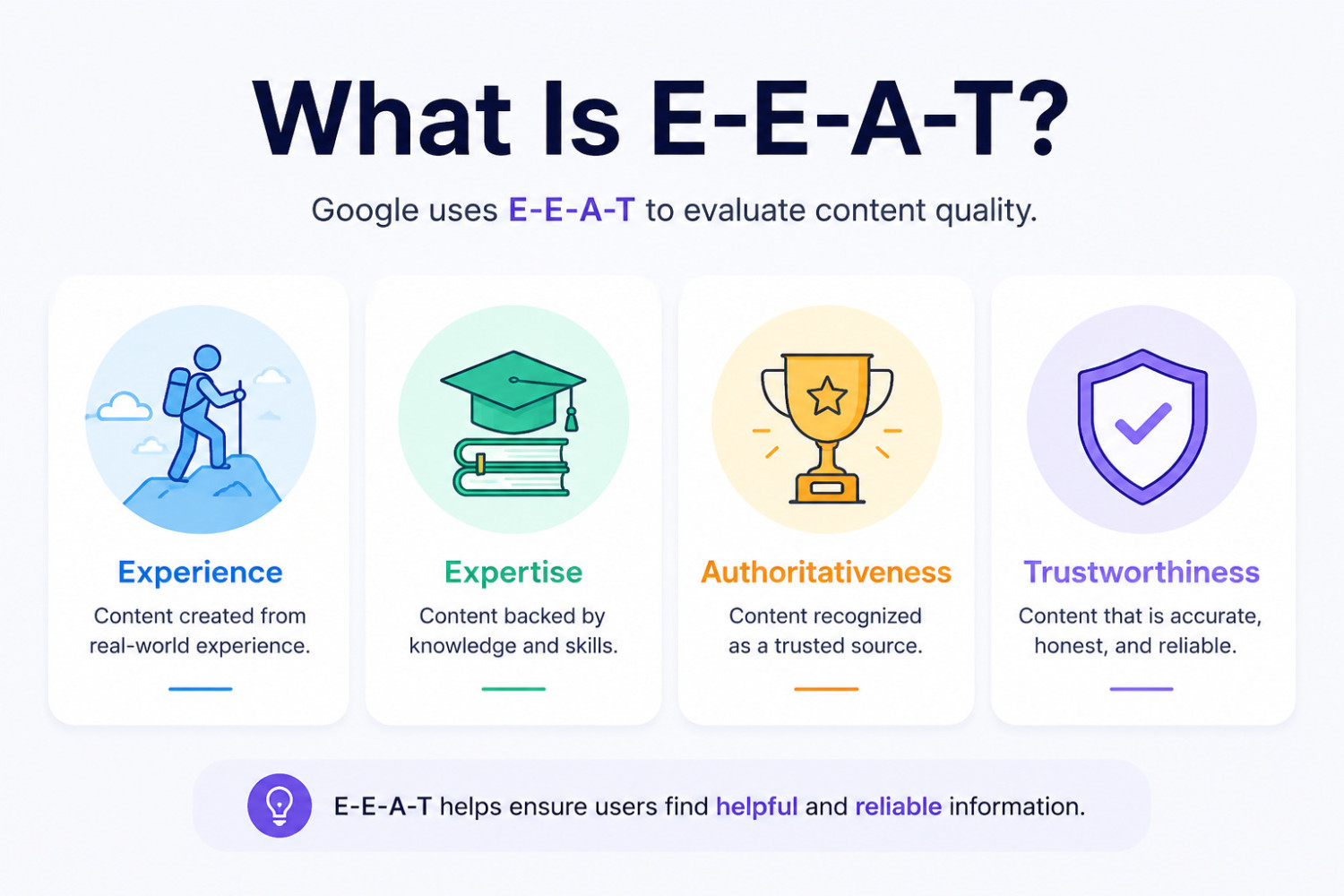
E-E-A-T is a concept Google uses to evaluate content quality. It stands for Experience, Expertise, Authoritativeness, and Trustworthiness. In simple terms, E-E-A-T is not about stuffing a page with keywords. It is about whether the content is genuinely useful, whether it comes from real experience, whether the writer or brand understands the topic, and whether readers can trust it.
Think of it like a college paper. A professor does not give a high grade just because the paper is long or nicely formatted. They look at whether you understand the topic, whether you used reliable sources, whether your argument has evidence, and whether the work feels honest and credible. Website content works in a similar way. A page can look polished, but if it has no real examples, no author information, no clear sources, and no useful details, it will be harder for people and search systems to trust it.
For search engines, E-E-A-T is a way to understand content credibility. For AI search and large language models, it also matters because AI systems need to decide which information is worth summarizing, citing, or recommending. That is why E-E-A-T is closely connected to AI search. AI does not only read words on a page; it also tries to understand context, evidence, structure, and trust signals.
The Four Parts of E-E-A-T
Experience means the content shows first-hand or real-world experience. For example, a product review written by someone who actually used the product is usually more helpful than a page that only rewrites the product specifications. In business content, experience can appear through case studies, screenshots, customer situations, service workflows, before-and-after comparisons, and lessons learned from real projects.
Expertise means the content shows real knowledge of the topic. In fields like health, law, or finance, readers need to know whether the writer has relevant qualifications or professional background. But expertise also matters in topics like SEO, website optimization, and AI search visibility. Saying “we are experts” is not enough. A strong page explains the problem, the method, who it applies to, and where the limitations are.
Authoritativeness means the person, brand, or website is recognized as a relevant source for the topic. You do not have to be a huge company to build authority. Clear positioning, consistent publishing, credible examples, customer proof, and third-party mentions can all help. To understand how brands may be mentioned by ChatGPT, Gemini, and Claude, you can also read Pimker’s AI citation study.
Trustworthiness is the most important part of E-E-A-T. It is about whether users feel the site is safe, honest, and transparent. Does the site show clear contact information? Does it explain service scope, pricing, or process? Is the content accurate and up to date? Does the page identify who created it? If a website is vague, exaggerated, or unsupported by evidence, it will be harder for both users and AI systems to trust it.
Why E-E-A-T Matters for SEO and AI Search
E-E-A-T matters for SEO because search engines want to show users content that is helpful and reliable. In the past, some people thought SEO was mostly about adding keywords, writing long articles, or building links. Those things may still have a place, but they are not enough. A page needs to solve a real user problem and make it clear why the information should be trusted.
In the age of AI search, E-E-A-T becomes even more important. When someone asks ChatGPT, Gemini, Claude, or Google AI search a question, the system needs to decide which sources and ideas deserve attention. If your website is clear, structured, credible, and specific, AI systems are more likely to understand who you are, what you offer, who you serve, and why your brand may be relevant.
For example, if a consulting firm only says, “We provide professional services,” an AI system may not know what the firm actually does. But if the site explains its target customers, the problems it solves, the process, real outcomes, FAQs, and case examples, it becomes easier for AI to connect that firm with the right type of user need. This is also why the Pimker service plans focus on positioning, content structure, internal links, and AI-readable pages.
How to Improve E-E-A-T on a Website
Improving E-E-A-T does not mean making your website complicated. It means adding clear signals of reality, expertise, and trust.
First, make the author or brand background clear. Readers should understand who created the content, what experience they have, and why they are qualified to talk about the topic. If AI helped produce the content, it can also be useful to explain whether a human reviewed or edited it.
Second, add concrete evidence. Real case studies, data, screenshots, customer feedback, step-by-step processes, comparison tables, and FAQs are much stronger than saying “we are professional.” These details also help AI systems understand, summarize, and cite your content more accurately.
Third, review the structure and readability of important pages. A tool like Pimker Lens can help analyze SEO, titles and meta descriptions, content improvements, FAQ opportunities, Schema recommendations, keywords, target audience signals, and AI search readability.
Simple Summary
E-E-A-T is a four-part way to think about content credibility. It does not mean every article has to sound academic. It means your content should show real experience, real knowledge, relevant authority, and strong trust signals.
For website owners, E-E-A-T is not only an SEO concept. It is a foundation for becoming a reliable information source for both people and AI systems. If your content is clear enough for an 18-year-old college student to understand and structured enough for an LLM to parse, your website has a better chance of being discovered in search results, AI answers, and brand recommendation moments.