

Will AI Search Replace Traditional Search?
AI search probably will not completely replace traditional search, but it will change how many people look for information. A more realistic way to think about
AI search probably will not completely replace traditional search, but it will change how many people look for information. A more realistic way to think about it is this: people will use both AI search and traditional search, depending on what they are trying to do.
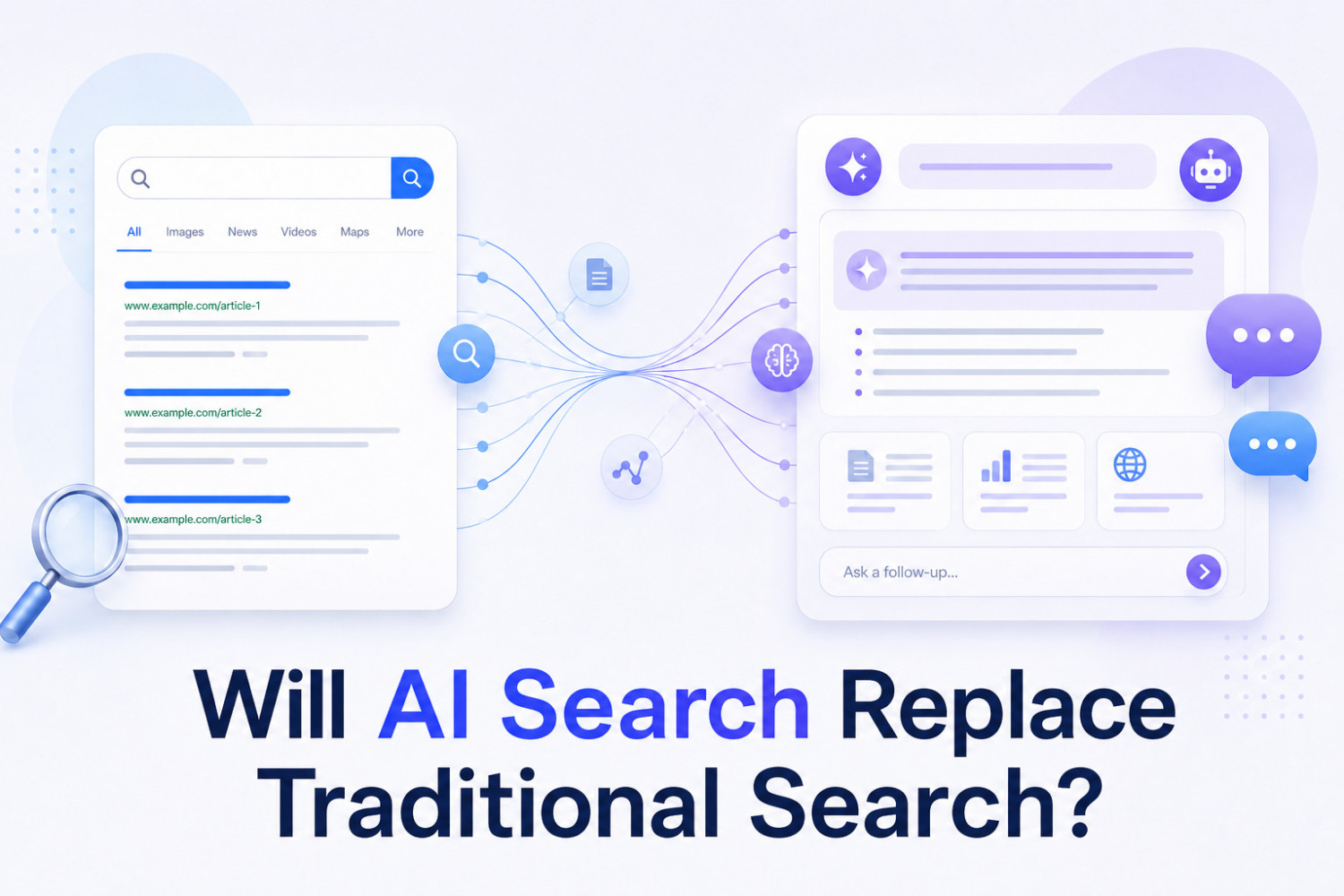
Traditional search is like a library catalog. You type in a keyword, and the search engine gives you a list of web pages, articles, videos, news results, or official websites that may be relevant. You then decide which results to open, which sources to trust, and how to compare them. The strength of traditional search is that it gives users direct access to many original sources.
AI search is more like a teaching assistant who summarizes the material for you. When you ask a question, AI tries to understand what you really mean, then organizes relevant information into a clear answer. It does not only show links. It can summarize, compare, group ideas, and sometimes suggest what to do next. This is why more businesses are paying attention to how AI search affects visibility, content strategy, and website structure.
AI search is especially useful when you want to understand something quickly. For example, questions like “What is the difference between SEO and AEO?”, “How can a small business get more website inquiries?”, or “How do these tools compare?” require explanation, organization, and comparison. AI can often save time in these situations because it turns scattered information into a more readable answer.
Traditional search, however, is still very important. When you need official information, a specific website, a full article, multiple source comparisons, recent news, academic references, or live pricing details, traditional search is often the better tool. For example, if you are looking for a company’s official website, a government announcement, a research paper, or breaking news, an AI summary may not be enough. You still need to visit the original source and check the details yourself.
So AI search and traditional search are better understood as tools with different roles, not as enemies. AI search helps users understand a topic quickly. Traditional search helps users verify details, compare sources, and read complete original content. For an 18-year-old college student, a simple comparison is this: AI search is like a classmate who explains the main idea, while traditional search is like going to the library and checking the references yourself. When writing a paper, AI can help you understand the direction, but you still need original sources and your own judgment.
For website owners, this change matters a lot. In the past, many SEO strategies focused mainly on Google rankings, keywords, and clicks. Now, there is another question: can AI understand your website? Can it identify what your brand does, who you serve, what problem you solve, and whether your content is trustworthy enough to recommend? This is closely related to E-E-A-T, which focuses on experience, expertise, authoritativeness, and trustworthiness.
That means future website content should be written for both humans and AI systems. Good content should clearly answer user questions and explain target customers, service process, pricing, case studies, FAQs, and differences from other options. This helps traditional SEO, and it also helps AI systems understand the page. If you want to check whether a single page is easy for AI to understand, you can use the free AI webpage score tool to review content completeness, trust signals, and AI readability.
In short, AI search will not make traditional search disappear, but it will make search behavior more conversational. Users may start with AI to get a quick direction, then use traditional search to verify sources and read deeper. For brands and websites, the best strategy is not choosing between AI search and traditional search. The best strategy is to make sure your website can be found by search engines and understood by AI systems.