

What Is AI Search Exposure?
AI search exposure means the chance that your brand, website, product, service, or content appears inside answers generated by AI search tools. These tools may
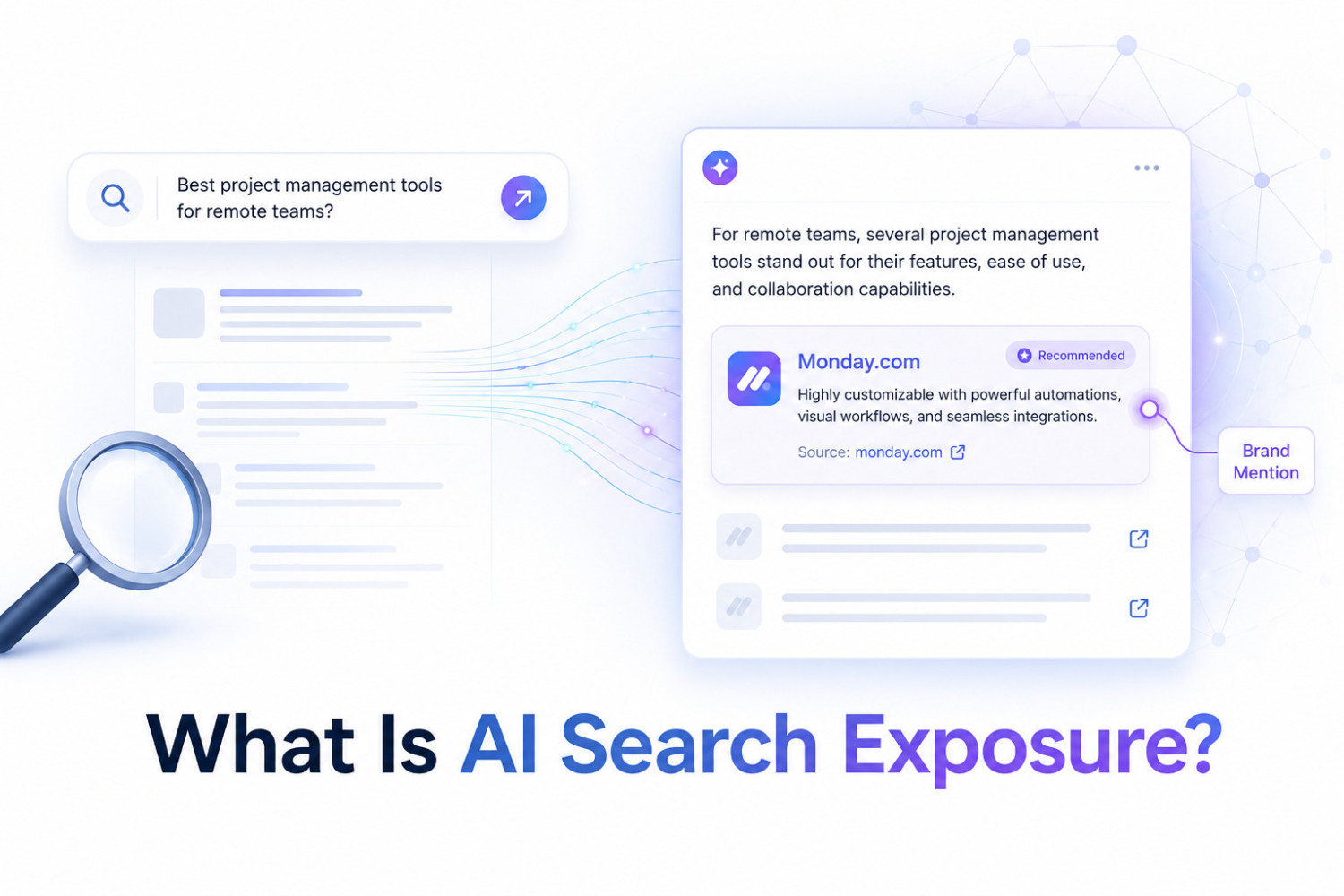
AI search exposure means the chance that your brand, website, product, service, or content appears inside answers generated by AI search tools. These tools may include ChatGPT, Gemini, Claude, Perplexity, or AI-powered answer experiences inside Google Search.
In simple terms, traditional “search exposure” usually meant where your website ranked in Google search results. AI search exposure means something slightly different: when a user asks an AI tool a question, does the AI mention your brand, cite your content, recommend your service, or include your website’s information in its answer?
For example, if someone asks, “What are good website optimization services for small businesses?” and the AI answer mentions your brand or lists your service as an option, that is AI search exposure. Even if the user does not click your website right away, they have already seen your name inside an AI-generated answer. That first impression can influence what they remember, compare, and trust later.
You can think of AI search exposure as a new kind of word of mouth for the AI era. In the past, customers might ask friends, check Google rankings, read blog posts, or look at reviews. Now, many users simply ask AI questions like “Which option should I choose?”, “Which company fits my needs?”, or “How should I solve this problem?” If AI can understand your site, trust your information, and connect your brand to the user’s question, you have a better chance of appearing in the answer.
AI search exposure is closely related to AI search. AI search does not only show a list of links. It tries to understand what the user is asking and organize information into a clear answer. That means website content should not only be written for traditional search engines. It also needs to be clear enough for AI systems to understand who you are, what you offer, who you serve, and how you are different from other options.
Trust also matters. If your website has clear service pages, FAQs, case studies, pricing explanations, company information, and contact details, AI systems have more context to understand whether your content is useful and reliable. This is related to the idea of E-E-A-T, which focuses on experience, expertise, authoritativeness, and trustworthiness. For AI systems, information that is clear, consistent, and specific is easier to interpret and reuse.
However, AI search exposure does not always mean immediate traffic. Sometimes an AI answer may mention your brand, but the user may not click your website right away. That still has value because exposure builds awareness. It is similar to hearing a brand name in class for the first time. Later, when you see that name again, it feels more familiar. AI search exposure can shape memory first, then influence later searches, comparisons, and buying decisions.
To improve AI search exposure, your website should answer real questions that customers are likely to ask. For example: “Who is this service for?”, “How does pricing work?”, “What is the process?”, “How is this different from other options?”, and “Are there examples or case studies?” The more complete and specific your content is, the easier it is for AI to connect your website with a relevant user need. A roadmap like the AI Search Growth Roadmap can help connect AI visibility, content optimization, internal links, and ongoing updates.
In short, AI search exposure means: when users ask AI tools a question, does your brand have a chance to be seen, understood, mentioned, cited, or recommended by AI? It is not a replacement for traditional SEO. It is a new visibility layer created by changing search behavior. In the future, websites need to be indexed by search engines and also understood accurately by AI systems.