In mid-May 2026, Anthropic shifted the commercial story around Claude from “model capability” toward something more concrete: workflow execution. The company introduced Claude for Small Business, allowing Claude Cowork to plug into tools widely used by small firms, including QuickBooks, PayPal, HubSpot, Canva, DocuSign, Google Workspace and Microsoft 365. It comes with 15 ready-to-run agentic workflows and 15 skills out of the box. At the same time, Anthropic expanded Claude’s legal offering with 12 one-click workflows for legal professionals and integrations with legal and contract systems such as iManage, NetDocuments, DocuSign, Ironclad and Thomson Reuters. The point of the launch is not simply that Claude has gained another batch of features. It is that Anthropic is trying to move generative AI out of the chat window and into the real operating flows of finance, contracts, research, legal review and marketing execution.
From a Chatting AI to an Operations Assistant That Runs Processes
According to Anthropic’s official announcement, “Introducing Claude for Small Business” (https://www.anthropic.com/news/claude-for-small-business), Claude for Small Business is not positioned as a new version of a chatbot. It is a package of connectors and workflow tools that embeds Claude inside existing business software. Users can enable the function in Claude Cowork, connect the software they already use, choose the task they want completed, and let Claude pull data across tools, organize information, suggest next actions and seek human approval before anything is sent, published or paid.
That product design marks a clear break from many earlier generative AI tools. In the first phase of enterprise AI adoption, use cases often stopped at drafting emails, summarizing documents, generating presentation outlines or answering knowledge questions. Claude for Small Business looks more like an operating-layer agent system. In Anthropic’s examples, Claude can help small businesses plan payroll by comparing cash positions in QuickBooks with PayPal inflows, building a 30-day cash-flow forecast, prioritizing overdue payments and preparing collection reminders. It can also assist with month-end closing by reconciling accounts, flagging anomalies, writing plain-English profit-and-loss commentary and exporting a package that can be handed to an accountant.
This means Anthropic is translating the somewhat abstract promise of “AI productivity” into everyday tasks that small businesses can understand. A local restaurant brand, an e-commerce seller, a boutique consultancy or an independent studio may not care whether a model wins a benchmark. It will care whether invoices can be chased faster, cash flow checked more reliably, promotional material prepared sooner, customer lists cleaned up, or contracts sent out for signature. Anthropic’s language this time is unusually close to the small-business market: instead of asking owners to learn AI, it puts AI into the tools those owners already use.
The Small-Business Market: Huge, Fragmented and Hard to Reach
Anthropic stresses in its announcement that small businesses account for about 44% of US GDP and employ nearly half of the private-sector workforce, yet their adoption of AI lags behind that of large companies. The claim points to the next contradiction in the generative AI market. The companies with the most resources to deploy AI are large enterprises, but the firms most burdened by tedious administrative work are often the smallest and least resourced.
Small businesses do not lack demand for AI. They lack the intermediate layer required to introduce it. Large enterprises can set up AI transformation offices, hire consultants, build internal data-governance procedures and connect APIs to ERP systems, CRM platforms or data warehouses. Small businesses live in a different world. They usually do not have dedicated IT teams, nor the time to understand agentic AI, MCP, connectors, data permissions and workflow orchestration. If an AI tool requires heavy configuration, or expects users to figure out prompts by themselves, adoption will easily stall at the trial stage.
That is why the real product strategy behind Claude for Small Business is to package complexity into templates. It includes 15 ready-made agentic workflows spanning finance, operations, sales, marketing, HR and customer service. It also includes 15 skills aimed at high-friction tasks that small-business owners repeatedly complain about. This “out-of-the-box” shape means Anthropic is not merely selling an AI model. It is selling an operating layer for small companies. If the model works, AI agents will no longer be projects only for engineers or large enterprises. They may become a semi-automated gateway into the back office of small businesses.
Legal Work: Claude Targets the Heavy Preparation Before Professional Judgment
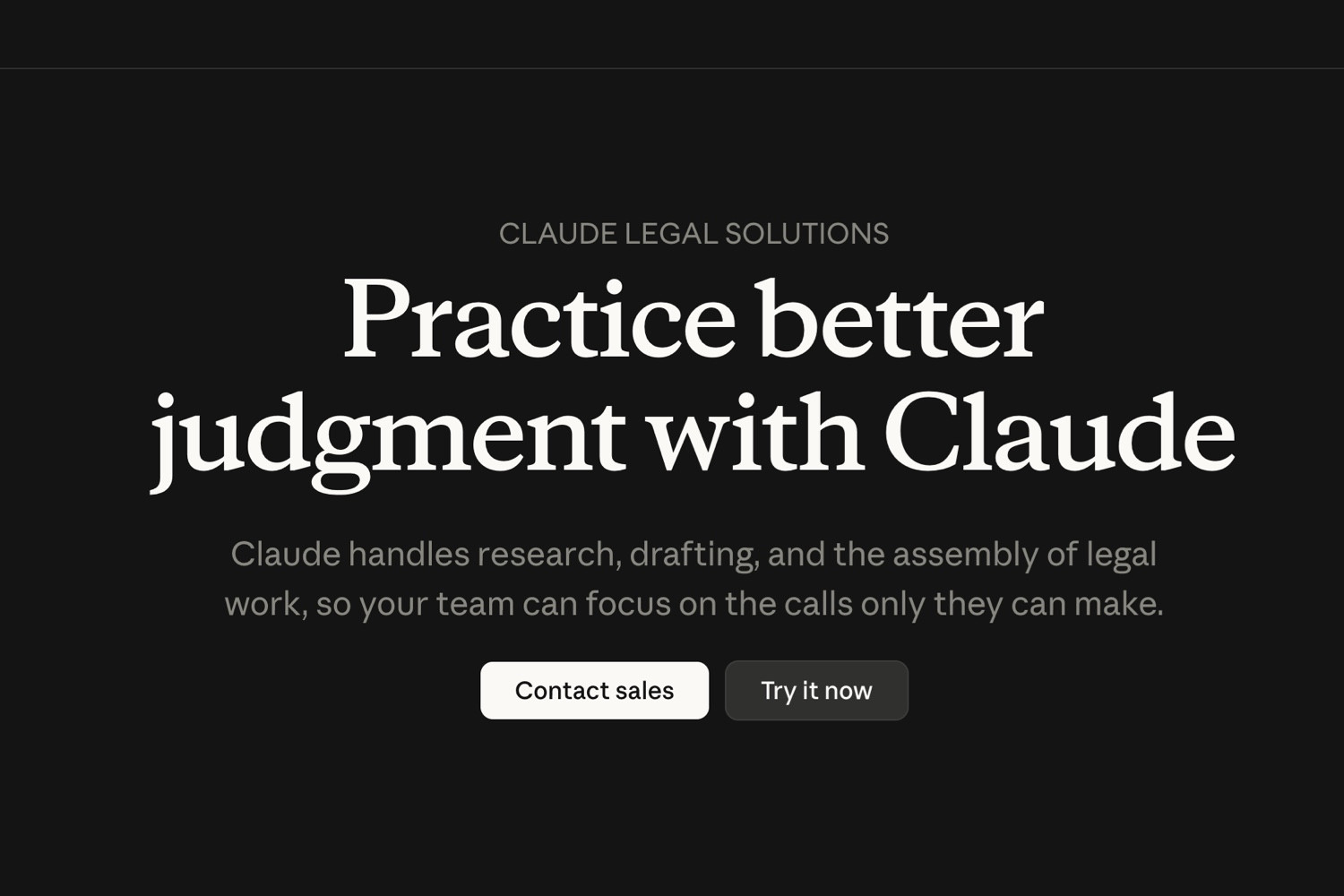
In the legal market, Anthropic’s approach is even more clearly aimed at professional workflows. According to Claude’s official page, “Claude Legal Solutions” (https://claude.com/solutions/legal), Claude can support legal research, drafting, document assembly and contract review, while connecting to tools including iManage, NetDocuments, DocuSign, Ironclad and Thomson Reuters. The page also emphasizes source-traceable outputs, enterprise security, full audit logs and the default position that Team and Enterprise plans do not train models on customer data.
Law is one of the most attractive, and most sensitive, markets for generative AI. It contains vast quantities of expensive text work, including case-law research, contract comparison, due diligence, regulatory compliance, outside-counsel invoice review and litigation-document organization. At the same time, false citations, hallucinations, data leakage and poor permission controls can all have serious consequences. Anthropic’s repeated emphasis on “traceable sources” and the idea that lawyers retain judgment is a direct answer to this market’s central anxiety.
Reuters, in its report “Anthropic expands Claude's AI tools for law firms, lawyers” (https://www.reuters.com/legal/litigation/anthropic-expands-claudes-ai-tools-law-firms-lawyers-2026-05-12/), said Anthropic had expanded Claude’s tools for law firms and legal professionals, including connections with Thomson Reuters, Harvey, Box, Everlaw and DocuSign, and launched 12 legal-practice-focused plug-ins or workflows. These designs are not meant to replace lawyers. They are meant to automate much of the preparatory work lawyers carry out before exercising professional judgment: reading documents, identifying differences, ranking risks, listing citations and then leaving legal professionals to decide how to interpret the findings and act on them.
Anthropic’s Strategy: From General-Purpose Model to Vertical Workflow
The simultaneous appearance of small-business and legal tools shows Anthropic accelerating its shift from being a “model company” to becoming a “workflow company”. As competition among large language models matures, model parameters, reasoning capacity or a reputation for safety are no longer enough to form a clear commercial moat. What enterprises and professional users are really willing to pay for is not the model itself, but whether that model can enter existing data environments, understand established processes, respect existing permissions and deliver results back into the tools already in use.
Claude Cowork plays a central role here. It is not merely a collaboration interface for Claude. It is the container through which Anthropic productizes agentic AI. For small businesses, it is packaged as operating templates for finance, marketing, customers and contracts. For legal users, it is packaged as research, due diligence, contract review, compliance analysis and outside-counsel management. The common logic behind these workflows is to make Claude a cross-tool executor rather than an answer engine trapped in a single window.
There is also a commercial necessity behind this strategy. AI models remain expensive to run, and the capability gap among foundation models may gradually narrow. If Anthropic wants to increase customer retention and willingness to pay, it must embed Claude in daily work and raise switching costs. Once Claude connects to QuickBooks, PayPal, HubSpot, Canva and DocuSign, or becomes the interface between law-firm document management, legal research platforms and contract systems, it is no longer just another replaceable chat tool. It begins to look like a new operating layer for enterprise processes.
From an international perspective, Anthropic’s move sits at the intersection of three major lines in global AI competition. The first is the platform race among large American technology companies. Microsoft is pushing Copilot into Microsoft 365 and Agent Store. According to Microsoft’s official article, “Bring your everyday business apps into the flow of work with agents in Microsoft 365 Copilot” (https://www.microsoft.com/en-us/microsoft-365/blog/2026/04/13/bring-your-everyday-business-apps-into-the-flow-of-work-with-agents-in-microsoft-365-copilot/), Microsoft’s proposition is to let AI not only help users understand the next step, but also bring business applications directly into the flow of work. This is highly similar to Anthropic’s direction: the AI battlefield is shifting from “answering” to “acting”.
Google is moving in a similar direction. According to the Google Cloud Taiwan official blog post, “Google Cloud於Next '26大會宣布開啟『代理式企業』新時代” (https://blog.google/intl/zh-tw/products/cloud/the_dawn_of_-the_agentic_enterprise_at_next_26/), Google emphasized Workspace Agent in Gemini Enterprise, enabling users to execute multi-step tasks across Google Workspace applications without leaving the Gemini Enterprise interface. OpenAI is also developing along these lines. According to OpenAI’s help page, “ChatGPT Business - 版本說明” (https://help.openai.com/zh-hant-hk/articles/11391654-chatgpt-business-release-notes), ChatGPT Business and Enterprise workspaces have been gradually introducing workspace intelligence agents that can connect to tools such as Google Drive, Google Calendar, Slack and SharePoint. Together, these moves show that AI agents are becoming standard equipment for American cloud and office platforms, not merely experimental products from start-ups.
The second line is the efficiency race in China. China’s AI application environment is more often built around high-frequency scenarios such as e-commerce, customer service, content generation, livestream sales, supply chains and enterprise messaging platforms. Although Anthropic’s services and market focus are currently concentrated mainly in the United States and allied markets, the pain points targeted by Claude for Small Business are highly familiar to Chinese small merchants: multi-platform operations, low margins, labor pressure and strong demand for rapid marketing and customer-service automation. The difference is that American AI agents emphasize compliance, permissions, review and non-training on customer data, while the Chinese market may place more weight on speed, cost and closed-loop conversion within platforms. That distinction will shape the pace at which AI agents land in different countries.
The third line is European regulation. Claude’s legal-solutions page demonstrates how a research framework can be generated for the EU AI Act and for implementation and enforcement trends in Germany, France and Italy. That is not accidental. The key question for AI in Europe is not only “can it be done?” but also “how can it be audited, traced and made consistent with data governance?” For Anthropic, if Claude is to go deeper into legal, financial and enterprise workflows, Europe’s compliance demands may become a useful stress test for product design. An AI agent that can earn trust in a strict regulatory environment will have a better chance of entering higher-value professional-services markets.
Industry Impact: SaaS Will Not Disappear, But the Entry Point May Change
If Claude for Small Business and its legal workflows continue to expand, they will raise a subtle question for the SaaS industry: in the future, will users operate software, or will they command agents? For the past two decades, competition in enterprise software has centered on interfaces, functional modules, databases and process management. With AI agents, users may no longer open QuickBooks, HubSpot, Canva or DocuSign one by one. They may instead assign a task to Claude and let it call those tools in the background.
This does not mean SaaS will be replaced by AI. On the contrary, the more AI agents want to act, the more they need trusted systems as sources of data and endpoints for execution. QuickBooks still holds accounting data, HubSpot still holds customer relationships, DocuSign still controls the signature process, and iManage and NetDocuments still hold legal-document repositories. What may change is the entry layer. If Claude, Copilot, Gemini or ChatGPT becomes the main interface through which users assign work, the front-end value of SaaS products may decline, while data, permissions, workflows and API integrations become more important.
For small businesses, this could lower the complexity of software adoption. In the past, a small team using accounting, CRM, design, contract, email and document tools at the same time would often be dragged down by tool-switching and inconsistent data. If AI agents can connect those tools into auditable workflows, the threshold for small-business digitization may fall. At the same time, however, this would make small businesses more dependent on a handful of AI platforms. When invoice chasing, payroll planning, marketing campaigns and contract review all pass through a single agent interface, platform lock-in and data-concentration risks will rise.
Limits and Challenges: Trust Cannot Be Built by a Single Launch
Anthropic stresses that users retain control, existing permissions are not bypassed, and Team and Enterprise plans do not train on customer data by default. These design choices are crucial for market adoption, but they do not mean the problem is solved. One of the biggest AI obstacles for small businesses is that they want to save time, yet lack the spare capacity to deal with the consequences when AI makes a mistake. A wrongly sent collection email, a misread contract flag or an erroneous cash-flow forecast can impose disproportionate risk on a small company.
The legal market is even more demanding. AI can accelerate document retrieval and drafting, but legal responsibility still rests with professionals. If Claude flags the wrong clause, misses a key precedent or cites material that requires further verification, a lawyer cannot simply shift responsibility to the model. This is why Claude’s legal offering repeatedly stresses source traceability, human review and auditing. The value of AI in legal work may not be “full automation”, but rather getting lawyers faster to the point where judgment is required.
Agentic AI commercialization also faces challenges around integration depth and cost. The more connectors there are, the more complex permission management becomes. The closer workflows get to real operations, the more exceptions they encounter. Small-business processes are often unstandardized, and the working styles of law firms and in-house legal teams are even more customized. If Anthropic wants these workflows to be genuinely useful, it must find a balance between templates and customization. Too standardized, and they cannot handle real-world messiness. Too customized, and deployment costs begin to resemble traditional enterprise-software projects.
In the Medium and Long Term, AI Agents Will Reshape the Division of White-Collar Work
The medium- and long-term significance of this launch is not simply that Claude has gained another set of workflows. It is that the division of white-collar work is being redrawn. In the past, companies divided work between human decision-making and software tools. Now a new AI-agent layer is appearing in the middle, responsible for reading, organizing, comparing, tracking, reminding, drafting and conducting initial analysis. Humans still retain decisions, but more of the preparation before those decisions will be handed to AI.
In small businesses, this could free owners from administrative chores and allow them to spend more time on customers, products and cash-flow judgment. In legal settings, the work of junior lawyers and legal staff may be pushed upward, from large amounts of first-pass document review toward denser risk assessment, client communication and strategic analysis. This will not eliminate the need for professionals, but it may change how they are trained. If AI can perform the basic work through which junior staff once accumulated experience, organizations will need to rethink how newcomers learn judgment.
For the AI industry, Anthropic’s move also shows that competition is entering a more practical stage. Models still matter, but the market will increasingly care about who can connect to real data, complete real workflows, meet real audit requirements and persuade users that AI will not overstep its authority. The shared message of Claude for Small Business and Claude’s legal tools is that if AI agents are to become the next interface for business software, they must combine capability, integration and trust.
Anthropic has pushed Claude closer to the core of enterprise and professional services. But this contest will not be settled by a single launch. Microsoft owns the office-software gateway, Google controls Workspace and cloud data, OpenAI has a broad ChatGPT user base, and Chinese platforms are honing efficiency in high-frequency commercial scenarios. Whether Claude can secure a position in small businesses and the legal market will depend on whether it can turn “agentic AI” from an impressive demonstration into a work habit people can trust every day. That may be the hardest and most important step as generative AI moves from boom cycle to infrastructure.