AI News | Editor: Sandy
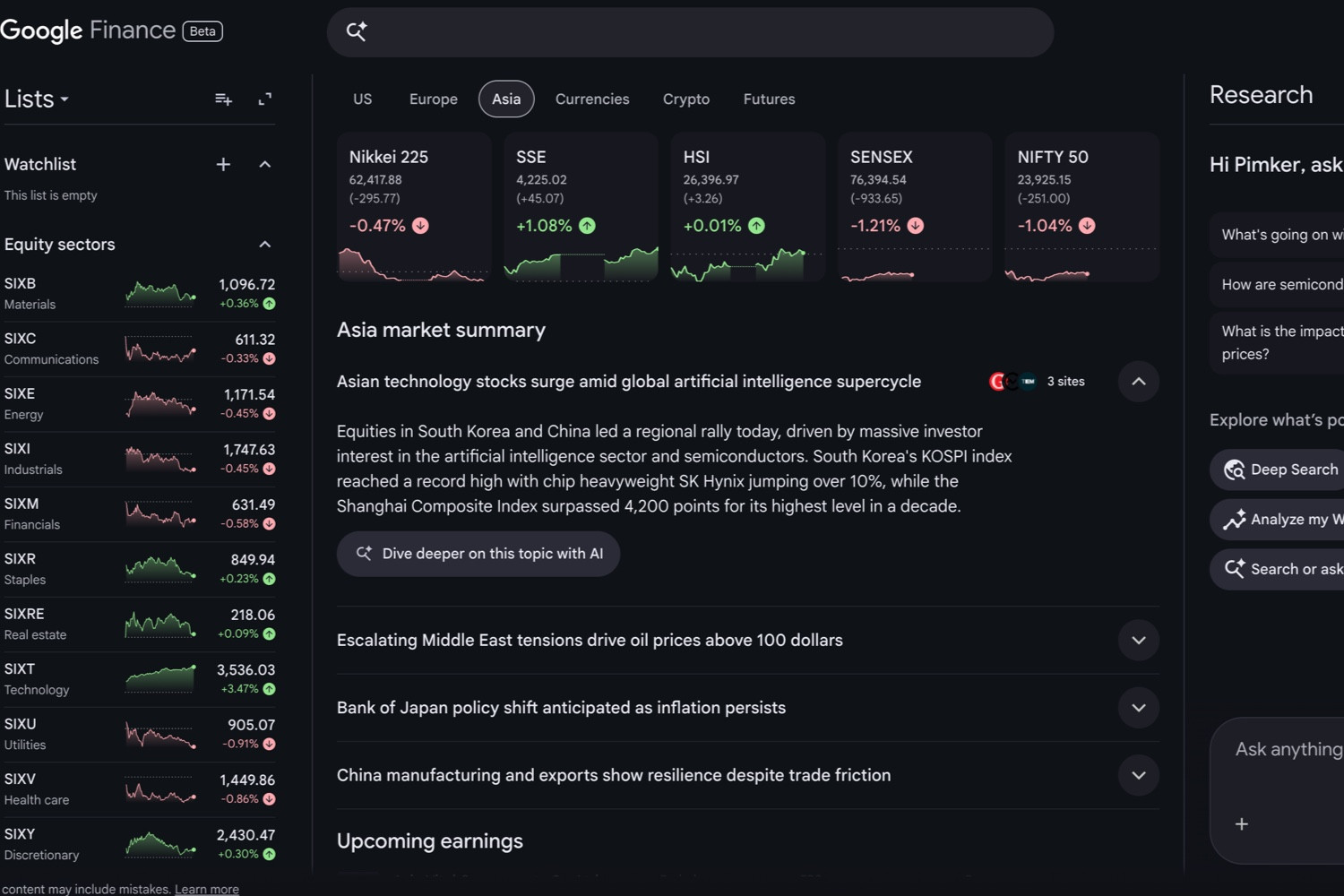
Google announced this week that its redesigned, AI-powered Google Finance is officially expanding across Europe, with full support for local languages. This is not a routine product refresh. It is Google’s attempt to fold financial search, real-time market intelligence, corporate earnings calls and investment research workflows into a single AI-driven entry point. According to Google’s official blog post, “The new AI-powered Google Finance is expanding to Europe.” (https://blog.google/products-and-platforms/products/search/ai-powered-google-finance-in-europe/), the new Google Finance will allow users to ask natural-language questions about individual stocks, sectors and broader market trends, receive comprehensive AI-generated responses, and follow links for deeper reading. At the same time, Deep Search in Google Finance is now globally available, moving more complex financial queries beyond simple price lookups or news summaries.
The announcement matters because it brings Google’s long-standing strengths in search, information organisation and digital distribution into a field with higher professional barriers: financial decision-making. The financial information market has historically been dominated by premium professional platforms such as Bloomberg, LSEG, FactSet and S&P Global Market Intelligence. Retail investors and general users, by contrast, have often relied on Yahoo Finance, Google Finance, brokerage apps, TradingView, social platforms and financial news sites. By launching the AI-powered version of Google Finance in Europe, Google is not merely adding features. It is trying to redefine the rules of competition for the financial information gateway.
From Checking Stock Prices to Questioning the Market
The old Google Finance was mainly useful for quick access to stock prices, historical charts, company snapshots and related news. It functioned rather like a financial search card: a user entered a company name or ticker and received a concise overview. The new Google Finance, by contrast, clearly moves toward the role of a research assistant. Users are no longer limited to asking how a stock performed today. They can pose more open-ended questions, such as why a sector has been volatile recently, whether a company’s earnings signals matched market expectations, or how moves in commodities and cryptocurrencies may affect related equities.
Google stresses in its announcement that AI-powered research can answer questions ranging from individual stocks to broad market trends, while providing synthesised AI responses. This design reflects a shift in how financial information is consumed. Users are no longer satisfied with a single price chart or a handful of headlines. They increasingly expect platforms to turn fragmented information into understandable context. For professional investors, information overload is hardly a new problem. For retail investors, the harder task is often deciding which pieces of information actually matter to price movements. If Google can effectively connect search results, news sources, company events, earnings data and market indicators, it may turn Google Finance from a supplementary lookup tool into a pre-investment research portal.
That also distinguishes the new Google Finance from a generic chatbot. Financial questions are unusually dependent on timeliness, source credibility and data accuracy. A fluent AI answer that lacks sources or traceable evidence may increase the risk of misjudgement rather than reduce it. Google’s emphasis that AI responses will include links for further reading suggests that it still wants to preserve the core advantage of search: the answer is not the endpoint, but a gateway to more information.
Advanced Charts and Market Events: Making Price Moves More Explainable
The second major feature of the new Google Finance is advanced visualisation. Google says the new charting tools allow users to go beyond basic historical performance and view technical indicators, such as moving average envelopes. Users can also tap key moments on stock charts to learn why prices changed on a given day. This may sound like a product detail, but it addresses a long-running weakness in financial information products: charts show what happened, but they rarely explain why it happened.
On traditional financial platforms, technical indicators, company events, news flows and research reports are often scattered across different pages and tools. If Google can connect fluctuations on a chart with news, earnings, events and AI-generated analysis, it can reduce the cost of switching among sources. For general users, that makes market events easier to understand. For more active investors, it may become a tool for quickly assessing risks and opportunities.
Still, attributing stock-price changes to particular news items or events is inherently limited. Market prices are driven by expectations, capital flows, interest rates, algorithmic trading, corporate news and broad risk appetite. AI can help organise related events, but it should not be treated as a tool that can precisely explain every movement in a share price. If a platform presents something “possibly related” as though it were a confirmed cause, users may place too much trust in machine-generated narratives. That is one of the hardest boundaries for financial AI products: they must offer insight without making insight look like certainty.
Earnings Calls Become AI-Readable Databases
Another function of Google Finance with real industry significance is its support for corporate earnings calls, including live audio, synchronised transcripts and AI-generated insights, along with annotated highlights that help users focus on what matters. Earnings calls have traditionally been closely followed by institutional investors, analysts and specialist media. For ordinary investors, however, listening to an entire call is time-consuming and requires familiarity with financial language, management phrasing and the signals embedded in analysts’ questions.
AI summaries are changing that process. They can quickly highlight key passages about revenue growth, gross margins, capital expenditure, inventory, regional demand, AI spending, regulatory risk and management outlook. When combined with live transcripts, earnings calls cease to be an informational advantage reserved mainly for professionals. They become a searchable, comparable and summarised database accessible to a wider group of users.
This also explains why Google is placing the feature inside Finance rather than leaving it only in Search or Gemini. Earnings calls are a clear use case with dense, high-value information. When AI can provide synchronised summaries as an event unfolds, financial information platforms move beyond after-the-fact organisation and toward near-real-time analysis. That may put pressure on brokerage research, financial media and market data providers, because it weakens the traditional advantage of being the fastest to distil an earnings call into key takeaways.
Google’s Strategy: Extending Search Into High-Value Vertical Markets
Google’s decision to expand the AI-powered version of Google Finance into Europe carries several strategic meanings. First, Europe is a multilingual market, where demand for financial information is spread across English, German, French, Spanish, Italian, Dutch, Swedish and other language environments. Google’s emphasis on full local-language support suggests that it is not simply transplanting a US product into Europe. It is trying to use AI to help financial information services cross language barriers. That matters especially for a search company, because one of search’s core strengths is turning information from different languages and sources into usable answers.
Second, financial information is a highly commercialised field. Google Finance may not yet directly challenge Bloomberg Terminal in the high-end institutional market, but it may first target retail investors, financial content consumers and light professional users. If the AI-powered Finance experience becomes a more common entry point for market queries, Google can strengthen the value of its search, advertising, news referral and financial-data partnerships. This resembles Google’s broader strategy in travel, shopping, maps, local businesses and health search: aggregate demand first, then gradually keep more user behaviour within Google’s own interface.
Third, Google is defending its search business. In recent years, generative AI search and answer engines have grown rapidly. Perplexity, OpenAI, Anthropic and a range of vertical AI tools have all challenged the habits formed around traditional search pages. Financial information is one of the best arenas for demonstrating the value of AI search because users need more than links. They need structured answers, real-time data and verifiable sources. The AI-ification of Google Finance is, in part, Google’s answer to the argument that search will be replaced by answer engines. If answers are to become part of search, Google must ensure that those answers remain inside Google products.
From an international perspective, Google Finance’s expansion into Europe sits at the intersection of three forces. The first is competition among American technology companies and financial-information providers. Bloomberg launched BloombergGPT in 2023. According to Bloomberg’s official article, “Introducing BloombergGPT, Bloomberg’s 50-billion parameter large language model, purpose-built from scratch for finance” (https://www.bloomberg.com/company/press/bloomberggpt-50-billion-parameter-llm-tuned-finance/), the model was built specifically for the financial domain and designed for financial natural-language-processing tasks. Bloomberg’s approach centres on deep proprietary data and institutional clients. Google’s approach is closer to a mass-market entry point built on search distribution and multilingual coverage. The two do not necessarily overlap directly, but they represent two models of financial AI: one a premium, closed professional terminal; the other a broad, search-based platform.
The second force comes from emerging AI answer engines. Perplexity has already incorporated stocks, earnings and company data into an AI query experience. According to the official Perplexity Finance page (https://www.perplexity.ai/finance), the service positions itself around AI-based answers for timely and trustworthy information. Meanwhile, TechCrunch’s report, “Perplexity now supports live earnings call transcripts for Indian stocks” (https://techcrunch.com/2025/08/18/perplexity-now-supports-live-earnings-call-transcripts-for-indian-stocks/), noted that Perplexity had expanded live earnings-call transcripts to listed companies in India. This shows that competition in AI financial information is no longer confined to US equities. Fast-growing capital markets such as India are also becoming testing grounds. Google’s introduction of similar earnings-call and AI-summary capabilities in Europe suggests that large platforms are pushing these tools into more mainstream product layers.
The third force is European regulation. The European Union has long sought to impose stricter rules on digital markets, data governance and AI oversight. According to Reuters’ report, “EU to delay ‘high risk’ AI rules until 2027 after Big Tech pushback” (https://www.reuters.com/sustainability/boards-policy-regulation/eu-delay-high-risk-ai-rules-until-2027-after-big-tech-pushback-2025-11-19/), EU policymakers have discussed delaying some high-risk AI rules in order to ease administrative burdens and adjust the regulatory timetable. Even so, Europe remains one of the world’s most sensitive markets for AI regulation. As Google launches financial AI services in Europe, it will inevitably need to address transparency of sources, the risk of misinformation, consumer protection and the boundary between information and investment advice.
China offers a different point of comparison. Chinese fintech services are often deeply integrated with large platforms, brokerage apps, payments ecosystems and social content. Investors commonly obtain information through services such as East Money, Tonghuashun, Xueqiu, brokerage systems and the WeChat ecosystem. The potential of Chinese-style financial AI lies in user scale, trading scenarios and local data integration. Its limitations come from regulation, cross-border data flows and the degree of market openness. By contrast, Google’s opportunity in Europe lies in cross-language, cross-market and cross-asset information integration. Its challenges lie in EU regulation, data licensing and responsibility for financial information accuracy.
The medium- and long-term impact of the AI-powered Google Finance may not be that it immediately takes institutional clients from Bloomberg. Rather, it may redraw the tiers of financial research capability. In the past, professional research capacity depended heavily on access to data terminals, research reports, analyst channels and time. If AI tools can combine news, charts, earnings transcripts, company events and market data into natural-language answers, basic research capability becomes more widely available.
This democratisation has two sides. On one hand, it can reduce information asymmetry and help more users understand earnings, industry trends and market volatility. If retail investors can read earnings-call highlights more quickly, market information may circulate more evenly. On the other hand, if large numbers of users rely on the same AI summaries and the same event explanations, markets may develop new forms of behavioural homogeneity. When many investors see similar machine-generated interpretations, short-term trading sentiment could be amplified, especially in popular technology stocks, crypto assets or highly volatile commodity markets.
For financial media, the challenge is more direct. One of the traditional functions of financial journalism has been to translate market events quickly into intelligible narratives. If Google Finance can provide AI explanations directly on chart and earnings pages, users may have less reason to click through to news sites. Deep interviews, exclusive reporting, investigations and macroeconomic analysis will not be fully replaced by automatic summaries. But the value of routine market updates and earnings takeaways is likely to come under pressure.
For brokerages and investment apps, Google’s move is equally delicate. Brokerages own the trading relationship and account data, but Google owns the search entry point and cross-platform user behaviour. If Google Finance gradually becomes the pre-trade research gateway, brokerage apps may be forced to strengthen their own AI research tools, personalised alerts and pre-trade analysis. Future competition in financial products will not be only about commissions and trading experience. It will also be about who influences user judgement earlier.
Beyond Technical Innovation, Trust Is the Core Threshold for Financial AI
The new features in Google Finance show the practical value of AI in financial information, but they also highlight the hardest problem: financial AI depends not only on generative capability, but also on trustworthiness, timeliness and clear responsibility boundaries. An error in ordinary search may prompt a user to search again. An error in financial information can lead to investment losses. That means Google must design the product carefully so that AI answers are not presented as investment advice.
The idea of a “comprehensive response” is especially complex in financial contexts. AI can explain that a company’s share-price decline may be related to weak earnings, lower guidance or changing macroeconomic interest-rate expectations. But it must distinguish clearly among facts, inference and market opinion. If an answer mixes news, model interpretation and investment commentary, users may struggle to assess its reliability. Google’s use of links to provide sources is a step toward reducing that risk, but it does not fully solve the problem. The real test will come during volatile markets, breaking news, rumour cycles and moments of data delay.
Europe’s linguistic and financial-institutional diversity will also test the localisation capacity of AI systems. The disclosure rules, media ecosystems, investor preferences and regulatory environments of Britain, Germany, France, Italy, Spain and the Nordic markets are not identical. If AI simply translates an English-language market logic, it may fail to understand local financial contexts accurately. Google’s promise of full local-language support is a necessary condition, but not a sufficient one. Financial localisation is not merely a matter of language. It is also a matter of data, institutions and market culture.
The Deeper Meaning of the European Launch: AI Search Enters Professional Decision-Making
Seen in a broader context, the launch of AI-powered Google Finance in Europe suggests that generative AI is moving from general chat into professional decision-making environments. Early AI chatbots showcased writing, summarisation, translation and question-answering. The next stage of competition is about who can embed AI into frequent, high-value and data-rich workflows. Financial information is an archetypal example. It involves large volumes of public data, constant real-time change, clear user demand and commercial value, while also carrying high error costs and regulatory sensitivity.
Google’s advantages are search, cloud infrastructure, Gemini models, news indexing, advertising foundations and global user reach. Its weaknesses are the depth of specialist financial data, licensing costs and the trust threshold required in financial contexts. The moat of institutional platforms such as Bloomberg is not merely their interface, but the quality of long-accumulated data, workflow stickiness and institutional trust. Startups such as Perplexity have the advantage of product speed and answer-native interface design. Google Finance sits somewhere between the two. It is not as institutionally focused as Bloomberg, nor as purely answer-centric as an AI startup. Instead, it is trying to embed AI into an existing mass-market financial search gateway.
That middle position may be an advantage, but it may also be a risk. If executed well, Google can use a low-friction path to bring large numbers of users into AI-assisted financial research. If quality is unstable, users may see it as a polished but unreliable summary tool. Financial markets do not lack information. They lack information that is trustworthy, timely and correctly understood. Google’s European expansion is therefore a test of whether large technology companies can move generative AI from “able to answer” toward “worthy of reliance.”
An Open Ending: The Fight for the Financial Gateway Has Only Begun
The arrival of AI-powered Google Finance in Europe may be seen in the short term as a feature upgrade within Google’s product portfolio. From an industry perspective, however, it looks more like an early signal of reshuffling in the financial information market. When search engines begin answering investment questions, when charts can be connected to events, and when earnings calls are transcribed live and annotated by AI, the threshold for financial research falls while competition in financial information moves up the value chain.
This contest will not be decided by model capability alone. Data licensing, regulatory compliance, source transparency, local-language quality, investor education and business models will all determine how far AI financial products can go. Google’s European launch shows that the search giant is no longer content merely to display financial data on a page. It wants to become the first layer through which markets are understood. Whether that makes investors more rational, or makes markets more dependent on homogenised machine narratives, will depend on how the product handles the delicate balance among information, risk and trust.