AI News | Editor: Sandy
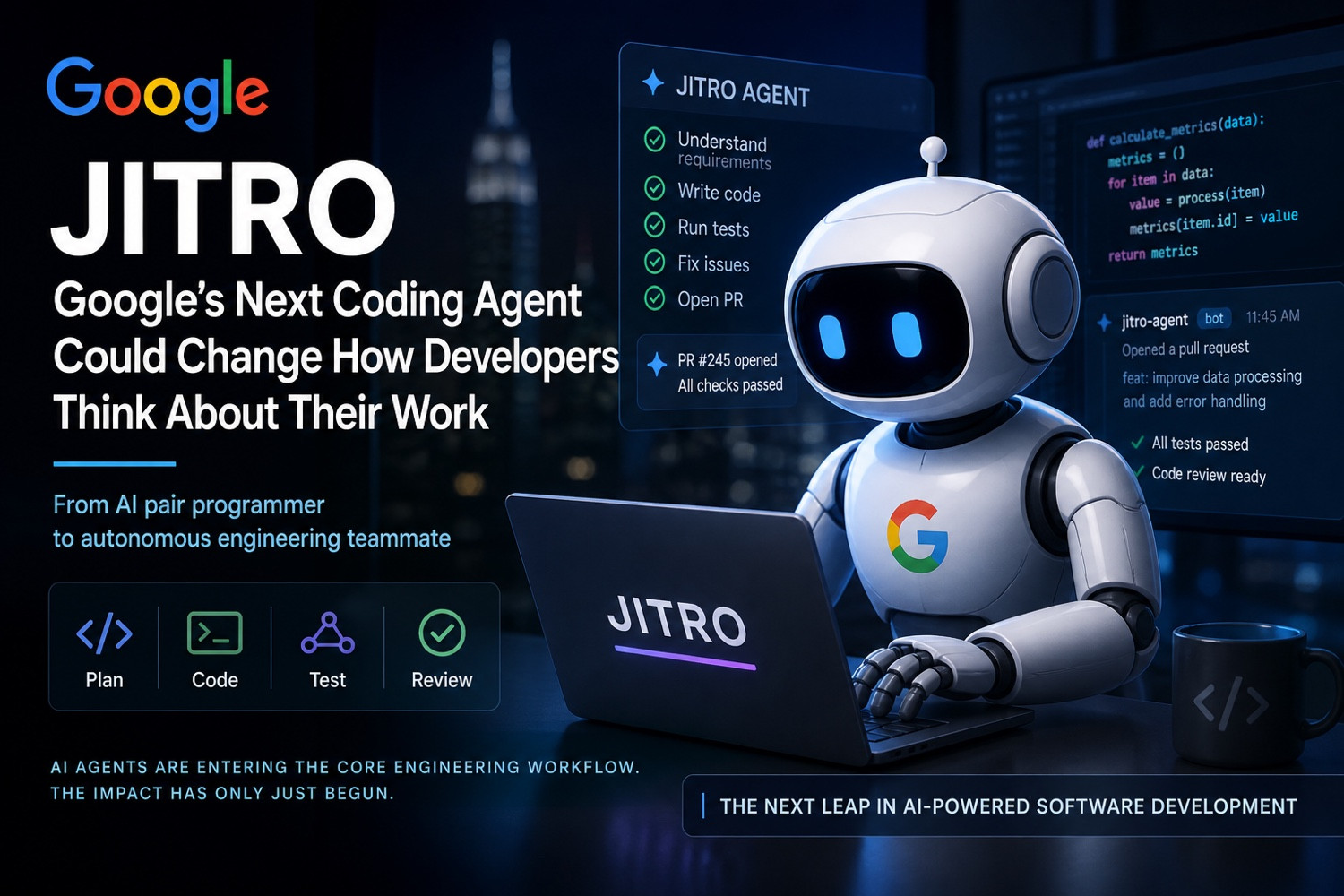
As of late April 2026, DevOps.com reported in “Google’s Next Coding Agent Could Change How Developers Think About Their Work” (https://devops.com/googles-next-coding-agent-could-change-how-developers-think-about-their-work/) that Google appears to be developing the next generation of its Jules coding agent under the internal codename “Jitro.” If those signals eventually turn into an actual product, this would not merely be another AI tool that fixes bugs, writes tests, or opens pull requests. It could mark a deeper shift in software-development tooling: developers would no longer tell an agent, line by line, which file to modify or which function to patch. Instead, they would set engineering goals such as “increase test coverage,” “reduce error rates,” or “improve accessibility compliance,” and let the agent decide which parts of the codebase need to change.
The shift matters because it touches the central question in the race to build AI coding agents. Over the past few years, much of the industry’s attention has been on whether models can complete code faster, understand large repositories more accurately, or pass tests more reliably. If the idea behind Jitro proves real, Google is trying to move the competition from “generating code” to “managing engineering outcomes.” That is a battlefield closer to the everyday reality of enterprise software development, and one that speaks directly to large organizations’ long-running anxieties over quality, security, efficiency, and governance.
Jules Is the Starting Point, Not the Destination
To understand Jitro’s potential significance, one must first look at where Jules already stands. According to Google’s official blog post “Build with Jules, your asynchronous coding agent” (https://blog.google/innovation-and-ai/models-and-research/google-labs/jules/), Jules entered public beta in May 2025 as an asynchronous, agentic coding assistant. It copies a developer’s repository into a secure Google Cloud virtual machine, understands the project context, performs tasks such as writing tests, fixing bugs, building new features, and updating dependency versions, then presents a plan, reasoning trail, and code diff when it is done.
That makes Jules different from traditional code-completion tools. Early versions of GitHub Copilot helped developers write the next line of code faster inside the IDE. Tools such as Cursor and Windsurf more deeply combined chat interfaces with code editors. Jules’ distinction is that it can work in the background. Google’s Jules documentation, “Getting started” (https://jules.google/docs/), also describes how Jules, after connecting to GitHub, clones code into a virtual machine, installs dependencies, modifies files, and allows developers to do other work while it runs. In that sense, Jules behaves more like a junior engineer who can be assigned a task than like an autocomplete tool hovering beside the cursor.
Google later pushed Jules closer to developers’ everyday workflows. According to the Google Developers Blog article “Meet Jules Tools: A Command Line Companion for Google’s Async Coding Agent” (https://developers.googleblog.com/en/meet-jules-tools-a-command-line-companion-for-googles-async-coding-agent/), Jules Tools lets developers launch tasks directly from the command line, check an agent’s status, and even weave Jules into automated workflows. This suggests Google is not content to keep AI inside a browser tab. It wants AI to enter the terminal, GitHub, CI/CD pipelines, and the broader machinery of enterprise engineering management.
From Prompts to KPIs: Jitro’s Real Ambition
What stands out most in DevOps.com’s description of Jitro is not the name, but the change in paradigm. Most coding agents still treat the “task” as their basic unit of work: fix this bug, add tests for this function, migrate this API to a newer interface. If Jitro is truly built around higher-level objectives, its working model would look closer to “KPI-driven development.” Developers or engineering managers would no longer need to break every ticket into tiny steps. Instead, they would define measurable engineering outcomes, and the agent would move across code, tests, documentation, and deployment context to find changes that improve those metrics.
This may sound like management language intruding into programming, but it is not an empty slogan. The problems in large codebases are often not single bugs. They are accumulated technical debt, testing blind spots, aging dependencies, performance regressions, and security risks. Human engineers can certainly deal with these issues, but such work is often delayed because it is insufficiently visible, not especially glamorous, or difficult to fit into short-term product roadmaps. If an agent can continuously track goals within controlled boundaries, propose remediation plans, and submit batches of changes, the value of AI in software engineering would shift from “accelerating individuals” to “reducing organizational friction.”
That may also explain why Google would be interested in Jitro. The Gemini ecosystem needs more than chatbots or model APIs. It needs products that prove models can enter high-value workflows. Developer tools are one of the best proving grounds: code can be tested, changes can be diffed, workflows can be audited, and results can be measured through indicators such as test coverage, build pass rates, defect rates, and deployment frequency. In other words, software engineering is easier than many other forms of knowledge work to verify, and therefore easier to monetize through subscriptions and cloud-computing usage.
If Jitro moves toward goal-driven agency, it will enter a crowded but still unsettled market. Microsoft and GitHub are closest to the enterprise-development backbone. According to GitHub’s official press release “GitHub Introduces Coding Agent For GitHub Copilot” (https://github.com/newsroom/press-releases/coding-agent-for-github-copilot), GitHub introduced the Copilot coding agent at Microsoft Build 2025, presenting it as an asynchronous agent embedded in GitHub and VS Code. It can be launched from GitHub issues or Copilot Chat, while draft pull requests, session logs, human review, and branch-protection rules help keep it under control. GitHub’s advantage is not a single model, but its grip on the world’s developer-collaboration layer.
OpenAI approaches the market from ChatGPT and model capability. According to OpenAI’s official announcement “Introducing Codex” (https://openai.com/index/introducing-codex/), Codex is a cloud-based software-engineering agent that can work on several tasks in parallel, including writing features, answering questions about a codebase, fixing bugs, and proposing pull requests, all inside isolated environments preloaded with the user’s repository. OpenAI’s narrative is to turn the coding agent into a “software-engineering teammate” inside ChatGPT. Its strength lies in model reputation and user access; its challenge lies in penetrating the development, permissions, and audit systems that enterprises already use.
Anthropic’s Claude Code places more emphasis on redistributing roles between engineers and agents. According to Anthropic’s product page “Claude Code | Anthropic’s agentic coding system” (https://www.anthropic.com/product/claude-code), Claude Code is “agentic, not autocomplete,” and presents a world in which engineers focus more on architecture, product thinking, and continuous coordination, while managing multiple agents and deciding what should be built. This overlaps strongly with the possible direction of Jitro: the next stage of competition will not be about who writes the prettiest function, but about who can persuade engineering teams to hand a wider range of decisions to agents.
China and Europe Face Different Pressures
From an international perspective, American companies are tying coding agents to cloud services, developer platforms, and model subscriptions, turning the market into a platform war. Google has Gemini, Google Cloud, Android Studio, Firebase, and Workspace. Microsoft has GitHub, Azure, VS Code, and enterprise customers. OpenAI is expanding through ChatGPT, Codex, and partner cloud infrastructure. All of them are competing for the same prize: making AI the default layer of software production rather than an add-on.
China’s competitive logic is different. Baidu, Alibaba, Tencent, Huawei, and a range of start-ups are also investing in code generation and enterprise AI tools, but their efforts are more often tied to domestic cloud platforms, government and enterprise clients, data-compliance requirements, and locally controlled hardware-and-software ecosystems. For Chinese companies, the appeal of coding agents is not only saving engineering time. It is also about supporting large-scale internal system modernization, migrating legacy systems, and reducing dependence on external development toolchains. If American companies set global standards through GitHub and cloud sandboxes, Chinese firms may differentiate themselves through private deployment, intranet-based development environments, and vertical-industry scenarios.
Europe, meanwhile, will push regulation and trust to the foreground. If AI agents can autonomously modify code, they raise questions about explainability, responsibility, data processing, security audits, and supply-chain risk. For finance, healthcare, the public sector, and critical infrastructure, “what the agent did” is not merely an engineering question; it is a governance question. For goal-driven agents such as Jitro to enter large European enterprises, transparent reasoning records, change evidence, approval workflows, and rollback mechanisms may matter more than benchmark scores.
The Biggest Bottleneck Is Not Whether It Can Code, but Whether It Can Be Trusted
The most seductive part of the Jitro idea is also its greatest risk. When an agent is asked to fix a clearly defined bug, the blast radius is usually limited. When it is asked to “reduce error rates” or “improve security posture,” it may need to cross multiple modules, adjust tests, change dependencies, or even reinterpret system design. The closer such tasks get to real engineering management, the harder they become to validate through a single test run.
As a result, the future competition among coding agents will shift from “generation capability” to “control capability.” Enterprises need to know why an agent chose one modification path over another, which alternatives it ignored, whether it followed security policies, and whether it left enough records for a compliant environment. DevOps.com also cites Futurum Group’s view that, when agents pursue goals autonomously across production codebases, teams must understand the optimization targets, reasoning process, and constraints behind those actions. That observation goes to the heart of the matter: engineering organizations do not lack tools that can produce code. They lack tools that can be authorized, held accountable, and governed.
This also explains why Jitro, if it does launch, may not be made broadly available at once. Goal-driven agents are best suited to large, mature codebases, but those are also the highest-risk environments. For Google, the most plausible route may be to introduce such a system first through a waitlist or controlled preview, allowing enterprises to test it under limited permissions, limited repositories, and limited goals before gradually expanding the agent’s autonomy.
The Industrial Meaning: The Engineer’s Role Is Being Redefined
The medium- to long-term impact of AI coding agents will not simply be “hiring fewer engineers.” What is more likely is that the center of gravity in engineering work will move upward. Junior tasks, repetitive repairs, test expansion, documentation updates, and dependency maintenance will increasingly be delegated to agents. Human engineers will spend more time setting objectives, reviewing designs, defining boundaries, assessing risks, coordinating multiple agents, and deciding product direction. That does not mean programming skill will no longer matter. It means programming will increasingly be intertwined with review, planning, architecture, and systems thinking.
For companies, the business model will also change. Developer tools have historically been sold through per-seat licensing. AI agents may add layers of model usage, cloud execution time, parallel task volume, and enterprise-governance features. Once an agent can work for extended periods inside a cloud virtual machine, the software-development tools market begins to resemble the cloud-infrastructure market. That is an opportunity for Google, because it can connect Gemini, Google Cloud, and developer tools into a closed loop. But it is also a challenge, because Microsoft and GitHub already control the developer-collaboration entry point, OpenAI has strong model mindshare, and Anthropic has built loyalty among the agentic-coding community.
For users, the deepest behavioral change may be that the basic unit of engineering work is rewritten. Today, engineers create issues, write requirements, cut branches, and submit pull requests. Tomorrow, engineering managers may define a set of long-running engineering goals and allow multiple agents to keep proposing small, reviewable, reversible improvements in the background. It resembles self-driving software engineering: humans still hold the wheel, but more and more small operations are handled by the system.
An Open Ending: Jitro’s Fate Depends on Whether Google Can Wrap Autonomy in Governance
Jitro remains, for now, an internal project signal reported by outside media, not a product Google has officially launched. Any judgment about its functions, release date, or final name should therefore remain cautious. Yet the reason the report is worth watching is that it fits the direction in which the whole industry is moving: coding agents are no longer content merely to complete code. They are trying to enter task allocation, quality improvement, and engineering management.
If Google can take the asynchronous work model, cloud VM execution, GitHub integration, planning layer, and diff visibility already present in Jules, then upgrade them into a Jitro-like system with trackable goals, auditable reasoning, and configurable constraints, it could help push AI coding agents from “developer productivity tools” into “enterprise engineering-governance platforms.” But if transparency, permission control, and result verification fail to keep pace, autonomous agents may become another kind of technical debt—only this time, the debt would be generated automatically by AI. The next question, then, is not whether AI can write more code, but whether enterprises are willing to let it assume part of the responsibility for engineering outcomes.